
Remembering Sir Patrick Stewart

I wasn’t expecting the news of Sir Patrick Stewart’s passing to affect me quite as much as it did.
At 86, he had lived a long and remarkably successful life, and I suppose at that age, the passing of someone shouldn’t come as an enormous surprise. Yet, when I heard the news, I found myself genuinely upset. I was at work at the time, and I’ll admit there were moments when I had to hold back tears.
Perhaps part of it was the fact that I hadn’t realized he was ill. I had read about his involvement in the upcoming Avengers: Doomsday, where he would once again portray Professor Charles Xavier, and I suppose I took that as a sign he was still in reasonably good health. It never really occurred to me that we might be losing him so soon.
His passing came just days after Walter Koenig’s, whom most of us remember as Pavel Chekov from the original Star Trek. Losing two actors associated with a franchise that has been part of my life for so many years, in such a short time, was difficult to process.
And while I certainly never knew either man personally, there’s something about losing an actor whose work you’ve enjoyed for decades that can be surprisingly emotional.
Growing Up With Star Trek
Although Star Trek: The Next Generation premiered in 1987, I didn’t really get into the series until my early teens. By then, it had already established itself as a worthy successor to the original series, and over the years I became quite attached to its characters.
I was also fortunate enough to see all four of the Next Generation films in theatres, beginning with Generations and ending with Nemesis. Looking back, I’m rather grateful for that experience, even if the quality of those films varied considerably.
For years, however, I’ve had a somewhat complicated relationship with which Star Trek captain I actually prefer.
There’s a line in Weird Al Yankovic’s White & Nerdy where he ponders whether he prefers Kirk or Picard, and I have to admit that it’s a question I’ve asked myself more times than I care to remember.
William Shatner’s James T. Kirk and Patrick Stewart’s Jean-Luc Picard are two very different characters, and I think that’s part of what makes comparing them so interesting.
Kirk was adventurous, charismatic, occasionally reckless, and more than willing to bend the rules when circumstances demanded it. Picard, on the other hand, was considerably more reserved, diplomatic, and philosophical. He was the sort of captain who would rather resolve a confrontation through dialogue than immediately resort to force, although he was certainly capable of taking decisive action when necessary.
And then, just to complicate matters further, I watched Star Trek: Enterprise during bus rides to university and became rather enamoured with that series and its Captain as well.
In fact, Enterprise was the first Star Trek television series that I watched every single episode from beginning to end. I’ve seen most of The Next Generation and Deep Space Nine, and I’ve watched the entire original series, but there’s something about Enterprise and Jonathan Archer’s journey that I found particularly appealing.
So, when it comes to choosing a favourite captain, I suppose the answer is more complicated, as it is no longer Kirk vs Picard, but Kirk vs Picard vs Sisko vs Archer, with no clear answer in sight.
What Star Trek Has Always Meant to Me
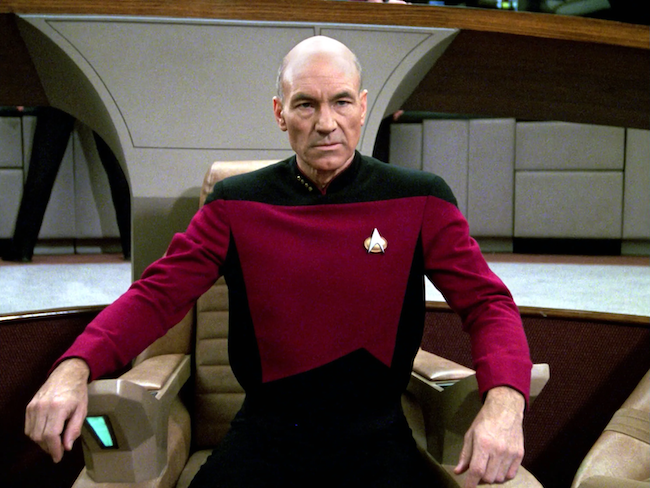
As much as I enjoyed The Next Generation, I still consider the original Star Trek to be the pinnacle of the franchise when it comes to using science fiction as a vehicle for exploring humanity.
One thing I’ve always appreciated about science fiction is its ability to tell stories that are ostensibly about the future, distant worlds, or advanced technology, while actually commenting on the society in which they were written.
Writers such as H. G. Wells and Isaac Asimov understood this particularly well in their works.
Wells’s The Time Machine, for example, wasn’t simply a story about a man travelling into the distant future. It was also a commentary on class divisions and the possible consequences of humanity’s social and economic development.
Likewise, Asimov’s stories weren’t merely about machines that could think. They explored morality, responsibility, the relationship between humanity and technology, and what it actually means to be human.
To me, that’s science fiction at its most fascinating.
And I think the original Star Trek frequently succeeded at doing something similar.
Whether it was examining racism, prejudice, war, authoritarianism, or the dangers of unchecked power, the series often used its futuristic setting to explore contemporary issues in ways that might otherwise have been difficult to present on television during the 1960s.
That’s not to say that The Next Generation didn’t accomplish similar things. Quite the contrary. Episodes such as The Measure of a Man, Darmok, and The Drumhead are wonderful examples of the franchise continuing that tradition.
And Patrick Stewart was a major reason those stories worked as well as they did.
His portrayal of Picard gave the character intelligence, dignity, and moral conviction that made even the most dialogue-heavy episodes compelling. He could deliver a speech about ethics, justice, or the responsibilities of command and make it every bit as captivating as a battle between starships.
There was something reassuring about Picard. He wasn’t infallible, and he certainly made mistakes, but you generally felt he genuinely tried to do the right thing.
I think that’s a large part of why the character has remained so beloved.
More Than Captain Picard
Of course, Patrick Stewart’s career extended far beyond Star Trek.
For an entirely different generation of moviegoers, he was Professor Charles Xavier in the X-Men films, another character whose intelligence, compassion, and moral convictions made him a natural fit for Stewart’s acting abilities.
It’s rather interesting that two of his most recognizable roles involved characters who, despite possessing considerable authority, generally preferred reason and diplomacy over violence.
I also remember being rather surprised when I watched David Lynch’s 1984 adaptation of Dune and discovered that Stewart played Gurney Halleck.
Of all the casting choices in that film, his portrayal of Gurney was certainly one of the more intriguing, particularly when viewed through the lens of someone who had already grown so accustomed to seeing him as Picard.
I’m sure I’ve encountered him in other films and television productions over the years, though I don’t necessarily remember every appearance. Much like how it can be amusing to revisit Independence Day and see Brent Spiner, whom I primarily associate with Data, playing the eccentric Dr. Brackish Okun.
It’s always a little strange to see actors you’ve associated with particular characters for so long appear in completely different roles.
And while Stewart had an extensive career in theatre, film, and television, I suspect many people of my generation will always remember him primarily as Captain Jean-Luc Picard and Professor Charles Xavier.
There’s certainly nothing wrong with that. Few actors are fortunate enough to portray even one character who becomes so firmly embedded in popular culture, let alone two.
One Last Voyage With Picard
In retrospect, I’m grateful we had the chance to see Patrick Stewart return to the role of Jean-Luc Picard in Star Trek: Picard one last time, even if I have some rather substantial reservations about the series itself.
I’ve only watched the first season and most of the second, and while I’ve heard the third season is considerably better, I can’t say I’ve been particularly impressed by some of the creative decisions in the show’s earlier episodes.
That said, I did find the second season intriguing in certain respects, particularly its exploration of Picard’s childhood and his relationship with his mother. I couldn’t help but wonder whether some of those creative decisions were influenced, at least in part, by Patrick Stewart’s own experiences growing up.
Stewart had spoken openly about his difficult childhood, including his father’s violent behaviour toward his mother. He later came to believe that his father may have suffered from what we would now recognize as post-traumatic stress disorder, having served during the Second World War.
Given that background, I wondered whether Picard’s family history in the second season might have been something Stewart felt a personal connection to. Of course, I can’t say whether that was the intention behind the storyline, but it’s an interesting possibility.
Whatever my criticisms of the series, I am glad that Stewart was given another opportunity to portray Picard, and that audiences had another chance to spend time with a character who had meant so much to them.
I’ve still got the remainder of the second season and the entirety of the third season to watch. Perhaps, in light of his passing, I’ll appreciate those episodes a little differently than I otherwise might have.
Saying Goodbye
I suppose one of the harder parts of getting older is watching the actors, musicians, writers, and other personalities who were part of your childhood gradually pass away. You know, intellectually, that it’s inevitable. Nobody lives forever, and when someone reaches their eighties or nineties, their passing shouldn’t come as a complete shock.
But knowing something is inevitable doesn’t necessarily make it any easier when it actually happens. I think what caught me off guard about Patrick Stewart’s death was how strongly I reacted. I hadn’t met the man. I didn’t know him personally. And while I’ve enjoyed his work for much of my life, I wouldn’t necessarily have expected the news of his passing to bring me close to tears while I was sitting at work.
Yet that’s precisely what happened.
Perhaps it’s because these actors become associated with particular periods of our lives. Watching The Next Generation reminds me of being a teenager, discovering the franchise, and becoming fascinated with its characters and the ideas it explored.
Seeing Picard on the bridge of the Enterprise-D brings back memories of a time that now feels increasingly distant.
And when someone like Patrick Stewart passes away, it feels as though another small connection to that period of your life has disappeared.
I’m grateful that I had the opportunity to enjoy his work for so many years, from watching The Next Generation on television to seeing its four films in theatres, and later watching him bring Professor Xavier to life on the big screen.
I’m also grateful that he continued acting well into his eighties, and that we’ll have one final opportunity to see him as Professor Xavier in Avengers: Doomsday.
For all my occasional indecision over Kirk versus Picard (or now, vs Sisko vs Archer), there’s no denying that Jean-Luc Picard was one of the great characters in science fiction television, and Patrick Stewart’s performance was instrumental in making it so.
Rest in peace, Sir Patrick Stewart.
And thank you for all those years aboard the Enterprise.