
Final Fantasy IX - A Celebration of Final Fantasy
Of the Final Fantasy games I’ve discussed so far, I think Final Fantasy IX is the one that best captures what I love about the franchise as a whole.
For years, my three favourites were IV, VI, and IX, with the first two usually competing for the top spot. Playing Final Fantasy VII Remake and Rebirth eventually made me reconsider where I placed the original FFVII, but that hasn’t diminished my appreciation for IX. Were it not for the sentimental attachment I have to IV and VI, and my relatively recent rediscovery of VII, I could just as easily see myself calling IX my favourite Final Fantasy.
Released for the original PlayStation in 2000, FFIX was the third and final mainline entry developed for that console. After two games that had taken the franchise in increasingly futuristic directions, Square decided to return to something resembling the fantasy settings of the earlier entries. We once again had knights, thieves, black mages, castles, kingdoms, and airships that actually looked like ships.
What I find particularly interesting, however, is that this apparent return to tradition doesn’t mean FFIX abandons the more ambitious storytelling or science-fiction elements of its predecessors. Beneath its charming, almost fairy-tale exterior is a fascinating story about the origins of life, mortality, identity, and what it means to exist.
And much like Final Fantasy IV and VI, I think it’s a game where practically everything comes together beautifully.
A Return to the Final Fantasy I Grew Up With
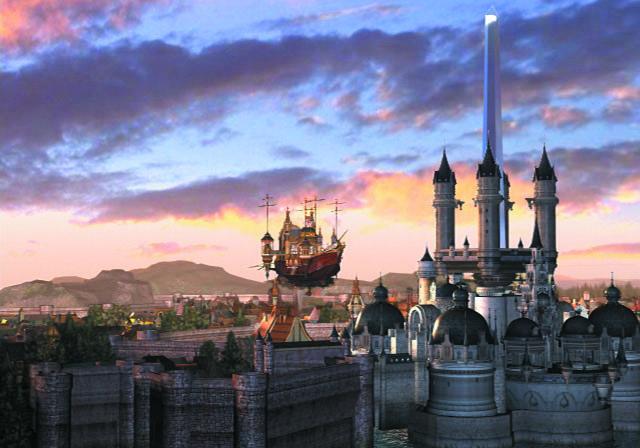
One of the reasons I immediately took to FFIX was how familiar its world felt. Having played through the first five games, it’s difficult not to appreciate just how much of their DNA is present here. The atmosphere reminds me of the more straightforward adventuring of FFI and III, the characters and their individual jobs evoke FFIV, and there are plenty of moments that feel like something out of FFV.
Even the opening party is essentially one of the most recognizable combinations of classes from the original Final Fantasy: a Thief, a Black Mage, a White Mage, and a Knight. Of course, Garnet is also a Summoner, but the parallels are pretty obvious.
It’s interesting to compare the three PlayStation games. FFVII took the industrialized world of FFVI and pushed it further into science fiction, while FFVIII gave us a military academy, futuristic cities, and a rather elaborate story involving time travel. FFIX looks almost like a rejection of that direction. In reality, it incorporates some of the same ideas into a setting that looks considerably more traditional.
There have always been elements of science fiction in Final Fantasy. Even the original game featured an advanced civilization and a fortress floating in the sky. FFIV took us to the moon, where we encountered an extraterrestrial civilization, and FFV featured two worlds that were originally one. In that respect, IX is probably more faithful to the spirit of the earlier games than it might appear at first glance.
I would describe it as a culmination of what Square had accomplished over the previous thirteen years rather than simply an attempt to make another old-school Final Fantasy.
A World That Looks Like It Belongs in an Animated Film
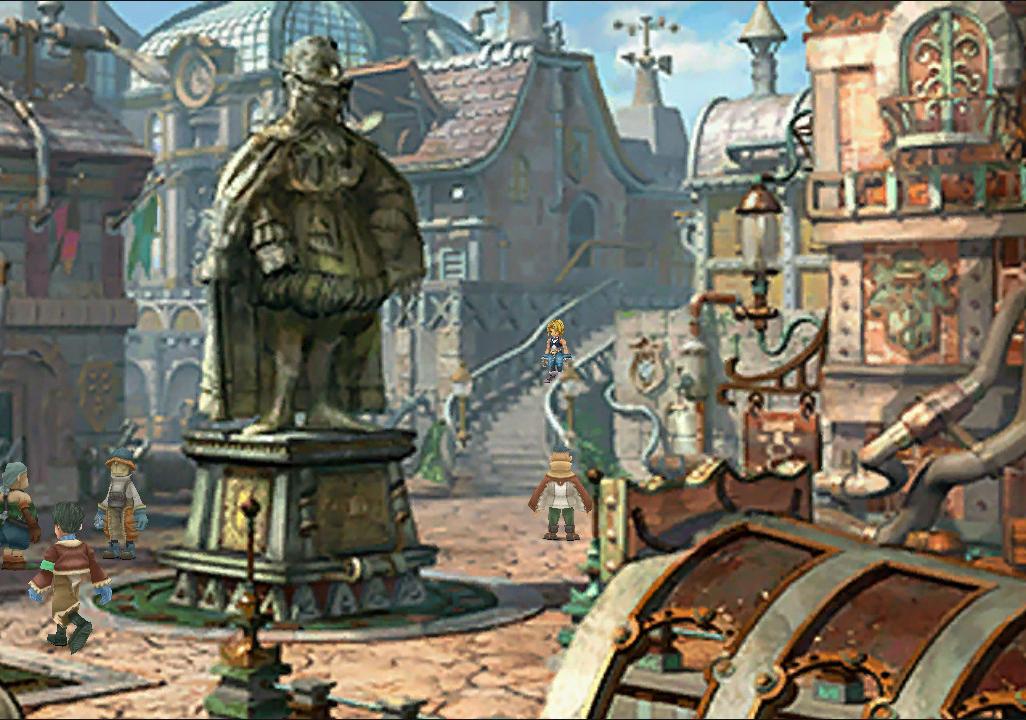
There’s something about the visual presentation of FFIX that I find absolutely wonderful. I sometimes struggle to decide whether it reminds me more of a Disney film, a Pixar production, or something from Hayao Miyazaki and Studio Ghibli. I think the latter is probably the closest comparison, particularly when I think of the imaginative worlds of films such as Princess Mononoke and Castle in the Sky.
I’m not suggesting that Square necessarily drew direct inspiration from those films, but there’s a similar sense of wonder in how the world is presented. There are elaborate castles, unusual creatures, beautiful landscapes, and entire cities that look as though someone had built an incredibly detailed miniature set and brought it to life.
Alexandria is probably one of the best examples. Its cobblestone streets, little shops, rooftops, and towering castle immediately establish the game’s storybook atmosphere. Lindblum has a completely different identity, with its airship docks, industrial districts, and enormous architecture. Treno looks like a city perpetually caught in the middle of the night, while the Black Mage Village has a much quieter, almost otherworldly charm.
Then there are locations like Burmecia and Cleyra, which demonstrate how beautiful environments can also be used to communicate sadness and tragedy. The rain in Burmecia does an excellent job of establishing the mood before much of the dialogue even takes place.
The pre-rendered backgrounds often have a diorama-like quality that I find particularly appealing. Much as I appreciate the technical achievements of FFVII and VIII, I think FFIX’s deliberate use of stylized character proportions has allowed it to age more gracefully. There was something slightly awkward about the transition between FFVII’s field models and the more realistically proportioned characters in VIII. IX seems completely comfortable with its own aesthetic.
It also doesn’t feel like a world that exists solely for the protagonists. There are people going about their lives, different races with their own cultures, and plenty of little conversations and details that have absolutely nothing to do with saving the planet. Those are the sorts of things that make exploring an RPG enjoyable to me.
A Kidnapping That Doesn’t Quite Go According to Plan
The story begins with the theatre troupe Tantalus arriving in Alexandria to perform I Want to Be Your Canary in honour of Princess Garnet’s birthday. The performance is actually a cover for their real objective: kidnapping the princess.
What makes the situation rather amusing is that Garnet wants to be kidnapped. She’s become increasingly concerned about her mother, Queen Brahne, and wants to seek the assistance of Regent Cid of Lindblum. Zidane and the others essentially find themselves helping their intended victim escape.
Meanwhile, a young Black Mage named Vivi is trying to attend the performance, only to discover that his ticket is counterfeit. He eventually finds his way onto the rooftops and becomes caught up in the chaos. Add to that the relentlessly dutiful Captain Steiner, who is desperately attempting to protect the princess, and you have one of my favourite openings in the entire series.
Much like FFIV, the game does an excellent job of using a relatively straightforward premise to gradually introduce a much larger conflict. Garnet’s concerns about her mother’s behaviour turn out to be quite justified, as Alexandria begins using manufactured Black Mages and powerful summoned creatures to wage war against neighbouring kingdoms.
What starts as an amusing kidnapping story eventually becomes an adventure that takes us far beyond the continent on which the game begins. It’s a wonderfully paced transition from lighthearted fantasy to something far more serious, without ever losing the charm of the opening.
One of My Favourite Casts in the Franchise
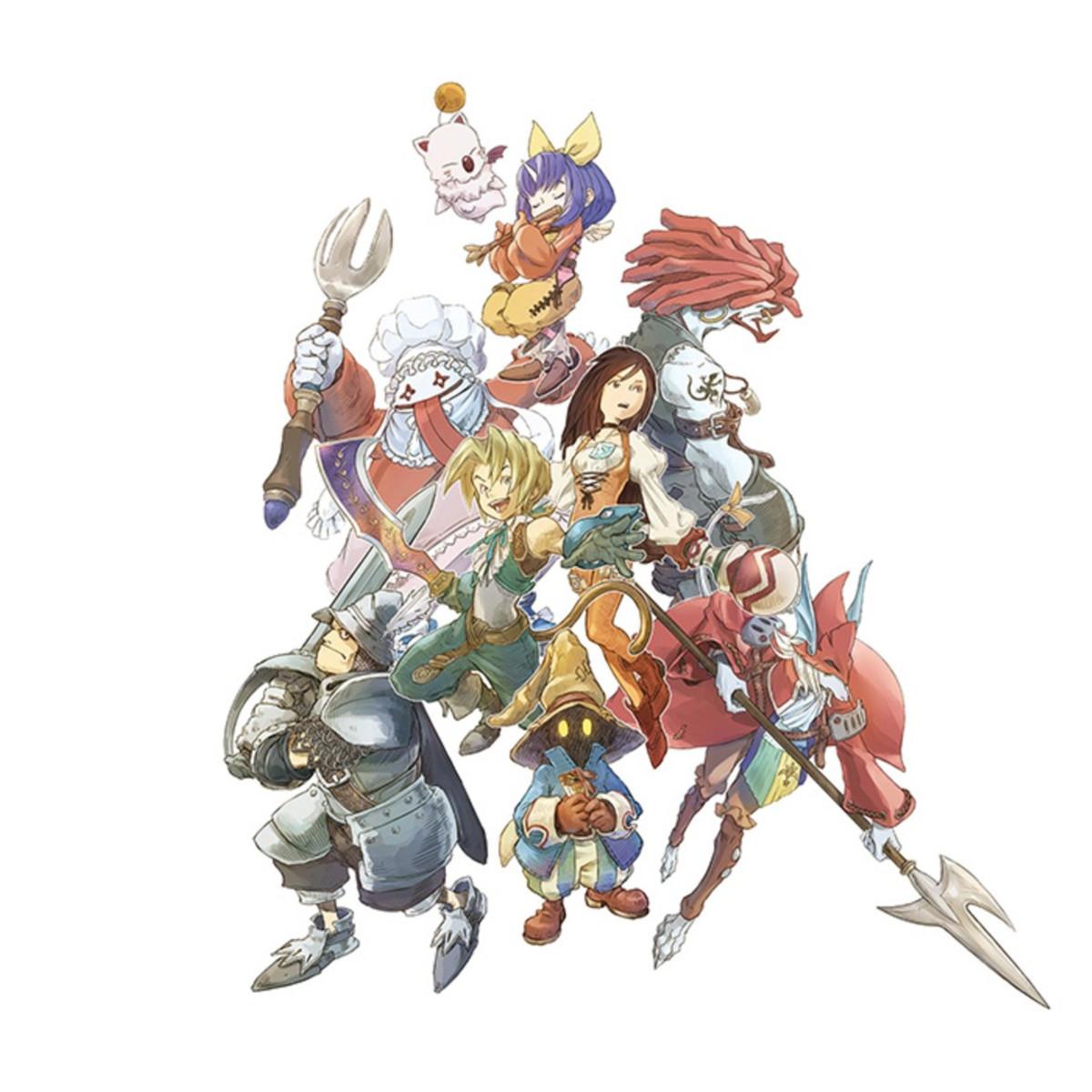
One thing I appreciated about Final Fantasy IV was how distinct its characters were, both in terms of their personalities and their roles within the party. FFIX takes a similar approach, and much like FFVI, it gives us a collection of characters whose personal stories contribute to the larger narrative.
Zidane Tribal is quite a departure from Cloud and Squall. After two games featuring protagonists who had considerable difficulty expressing themselves emotionally, it’s refreshing to have someone who is sociable, optimistic, and generally willing to help others without needing much of a reason. He can also be a bit of an idiot when it comes to women, but that’s part of his charm. The game eventually puts that optimism to the test in a way I particularly appreciate.
Garnet is another character I really like. She begins the adventure as a princess who has lived a relatively sheltered life, but she gradually comes to understand the world outside the castle and the responsibilities associated with her position. Her relationship with Brahne is particularly interesting because, despite everything her mother does, Garnet still loves her. Her relationship with Zidane also develops quite naturally over the course of the game.
Steiner is initially almost a caricature of an overly serious knight. His distrust of Zidane and admiration for Vivi make for some wonderful exchanges, but beneath the comedy is a man who has to reconsider what loyalty actually means. Is serving his queen unquestioningly the same thing as doing what is right for Alexandria? I like how the game allows him to grow without completely abandoning the personality that made him amusing in the first place.
Freya Crescent is probably one of my favourite Dragoons in Final Fantasy. Her search for Sir Fratley, the destruction of her homeland, and the feeling of having been forgotten by someone she loves make for a particularly sad story. I also like Beatrix, whose loyalty to Alexandria and eventual change of heart remind me somewhat of Celes from FFVI. I wouldn’t have minded having her as a permanent member of the party.
Eiko, meanwhile, is a young Summoner who has spent much of her life in the company of Moogles. Her loneliness and desire for a family are quite touching, and I find it amusing how seriously she takes her supposed romantic rivalry with Garnet. Amarant starts off as someone who believes that strength and independence are all that matter, whereas Zidane’s behaviour challenges practically everything he believes. And then there’s Quina, whose idea of personal development largely consists of finding more things to eat. I have to respect the simplicity of that ambition.
And of course there’s Vivi. I genuinely think he’s one of the best characters Square has ever created, but his story deserves a section of its own later in the article.
One of the things I love about the presentation of the characters is the series of portraits and quotations that appears if you leave the game sitting at the title screen. Each associates a character with a particular word, such as Sorrow for Vivi, Dilemma for Steiner, and Solitude for Eiko. It’s a lovely little touch, particularly once you understand how those words relate to their respective stories.
Gameplay: Four Characters, Distinct Jobs, and a Fantastic Ability System
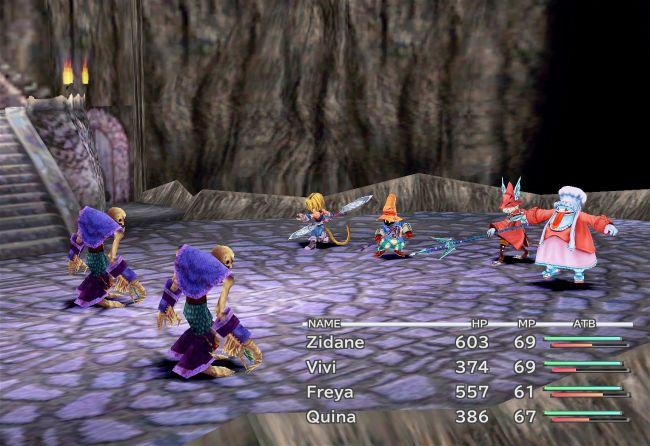
One change I was particularly happy about was the return to having four characters in battle. After FFVII and VIII restricted us to three, it was nice to once again be able to assemble a more traditional party. The last mainline game to feature four active party members had been FFVI.
FFIX also returns to fixed character classes. Zidane is a Thief, Steiner a Knight, Vivi a Black Mage, and Freya a Dragoon. Garnet and Eiko combine healing and summoning magic in different proportions, Amarant resembles a Monk with some Ninja abilities, and Quina is essentially a Blue Mage who learns abilities by eating enemies.
Having just discussed the Junction system in FFVIII, I particularly appreciate how straightforward character development is here. Equipment teaches characters abilities, which can be mastered by earning Ability Points in battle. Once an ability is mastered, you can continue using it after changing equipment, although support abilities need to be activated using a limited supply of Magic Stones.
This creates an interesting incentive to use equipment that might not necessarily provide the best immediate statistics. You might keep a particular weapon equipped for a little longer because there’s an ability you haven’t finished learning. Older equipment remains useful to other characters and can also be used in synthesis shops to create new items.
In some respects, it reminds me of FFVI’s Esper system, where equipping Magicite allows characters to learn spells permanently. The important distinction is that FFIX doesn’t allow everyone to eventually learn the same abilities. The characters retain the mechanical identities associated with their respective classes, which is something I’ve always liked about FFIV.
The combination of Vivi and Steiner is particularly neat. Steiner can use Sword Magic in conjunction with Vivi, allowing him to perform elemental sword attacks. It’s a nice example of the characters’ relationships extending into the gameplay itself, and it evokes the Mystic Knight from FFV.
The game retains the Active Time Battle system and introduces Trance, its equivalent of the Limit Break mechanic from VII and VIII. Depending on the character, entering Trance can grant access to new attacks, improve existing abilities, or allow multiple spells to be cast. It fits the setting rather well, particularly since Trance also has significance to the story.
I wouldn’t argue that the system is more elaborate than FFV’s job system or that it provides the same degree of customization as Materia or Junctioning. I just really enjoy how it brings together character individuality and a meaningful sense of progression without becoming unnecessarily complicated.
Active Time Events and Optional Content
Another feature I really like is the Active Time Event (ATE) system. While you’re controlling one character, you can occasionally see what the others are doing elsewhere. Sometimes these scenes are amusing, while others provide quite a bit of additional insight into the characters or the places you’re visiting.
Given how much I’ve praised the ensemble cast of FFVI, I appreciate that FFIX found another way to give individual party members attention even when they aren’t accompanying Zidane. It makes the party feel more like a group of people with independent lives rather than a collection of characters who simply follow the protagonist around.
FFIX also has a substantial amount of optional content. There’s Chocobo Hot and Cold, the treasure-hunting quests associated with the Chocographs, Mognet Central, the friendly monsters, and the Ragtime Mouse quizzes. There are optional encounters such as Hades and the superboss Ozma, who resides in the Chocobo Air Garden.
Tetra Master is an interesting successor to Triple Triad, although I still prefer the card game from FFVIII. Completing the friendly monsters quest, meanwhile, actually makes Ozma easier to fight by allowing physical attacks to reach it and making it vulnerable to Shadow damage. It’s a neat way of connecting two seemingly unrelated optional activities.
Chocobo Hot and Cold can get a little repetitive, and some of the secrets are rather well hidden, but there’s an enormous amount of stuff to discover. I don’t consider those things particularly significant criticisms of what is otherwise a wonderfully enjoyable RPG.
Music: Melodies of Life
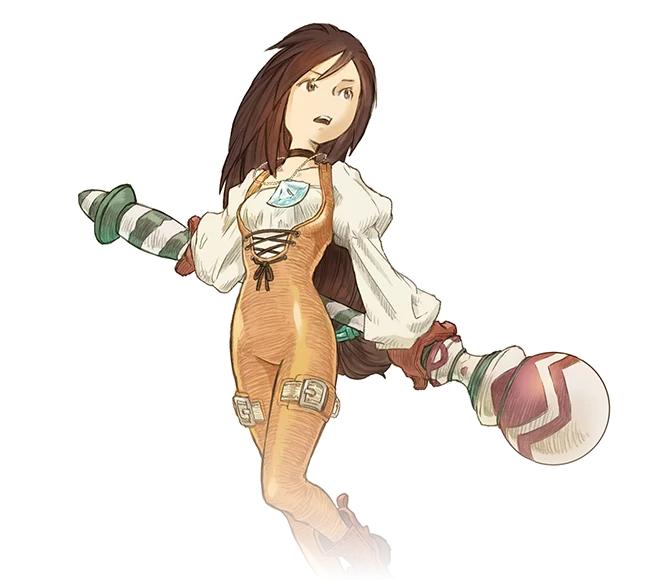
Nobuo Uematsu’s soundtrack is another reason I hold FFIX in such high regard. I think it does an exceptional job of capturing both the fairy-tale nature of the setting and the considerably darker themes beneath it.
If I had to choose a favourite composition from the game, it would probably be Melodies of Life. I like it considerably more than Eyes on Me from FFVIII, and I think it fits the game beautifully. Performed by Emiko Shiratori in both Japanese and English, the song feels like a wonderful summation of the game’s themes of life, memory, and the connections we make with others. The melody appears throughout the soundtrack, long before we finally hear the full vocal arrangement.
A Place to Call Home, the piece we hear at the title screen, is another favourite. Its instrumentation immediately establishes the medieval fantasy atmosphere. The same melody reappears in several forms, including some particularly memorable music associated with Oeilvert and the later portions of the game.
Vivi’s Theme wonderfully captures his personality, while Vamo’ alla Flamenco is a tremendously fun accompaniment to the theatrical sword fight in Alexandria. Over the Hill, the main overworld theme, has the sort of adventurous quality I associate with the earlier Final Fantasy games. Then there’s The Festival of the Hunt, which does a great job of building excitement during the competition in Lindblum.
Rose of May, Beatrix’s theme, is another beautiful composition. I also love You’re Not Alone!, particularly because of how effectively it’s used during one of the most significant moments in Zidane’s story. Sometimes a piece of music can transform an already excellent scene into something that stays with you for years, and I think that’s one of the best examples in the franchise.
Both Battle 1 and Battle 2 are excellent, and The Dark Messenger, the theme associated with Trance Kuja, is a suitably dramatic piece for the confrontation. Even The Final Battle is a fantastic composition, despite my reservations about the boss it accompanies.
I still think FFVII might have Uematsu’s finest overall soundtrack, and I have a particular fondness for Battle at the Big Bridge from FFV. But it’s remarkably difficult to find fault with the music in IX. It’s one of those soundtracks where just hearing a familiar melody is enough to bring back memories of the world and its characters.
The References to Everything That Came Before
FFIX is filled with references to earlier Final Fantasy games. In a 2000 interview, Hironobu Sakaguchi described the game as an opportunity to recapture the feeling of a traditional Final Fantasy world before the franchise moved to the PlayStation 2.1 It’s particularly fun going through the first eight games again and noticing just how many familiar names, designs, and ideas ended up in IX.
Here are some of my favourites, although this is by no means an exhaustive list. A few of these refer to locations or encounters later in the game.
- Final Fantasy I: Garland shares his name with the original game’s antagonist. Mount Gulug is a callback to Mount Gulg (or Gurgu Volcano in the original English localization), complete with a new arrangement of its music. Vivi resembles the classic Black Mage, Garnet’s disguise evokes the White Mage, and the four elemental fiends make another appearance.
- Final Fantasy II: Ramuh asks Garnet to piece together a story involving Josef, whose sacrifice actually occurred in FFII. Pandemonium also returns as a location, with its music drawing on the Emperor’s final dungeon.
- Final Fantasy III: The Invincible is named after the enormous airship from FFIII. You can also buy Doga’s Artifact and Une’s Mirror at the Treno Auction House and use them to hear an arrangement of Doga and Unei at the Black Mage Village inn. Having just replayed III, I particularly appreciate that one.
- Final Fantasy IV: Freya can obtain Kain’s Lance, while the Namingway card can be used to rename characters in Daguerreo. Cid’s surname, Fabool, evokes the kingdom of Fabul, and the opening airship music incorporates a little of The Red Wings. Eiko’s background also reminds me of Rydia, although the two characters have quite different personalities.
- Final Fantasy V: Steiner’s Sword Magic recalls the Mystic Knight, Boko appears on a Tetra Master card, and Atomos returns as an eidolon. Gilgamesh also makes an appearance as the rather mysterious four-armed man. The horns on IX’s Summoners recall the headgear associated with the Summoner job in III and V, but here the horn is actually part of the summoners’ anatomy.
- Final Fantasy VI: The Edgar’s Plain region recalls the name of Figaro’s king. The statues in Kuja’s Desert Palace evoke the Warring Triad, and there are some interesting parallels between Beatrix and Celes, as well as between Kuja’s eventual rebellion against Garland and Kefka’s betrayal of Emperor Gestahl.
- Final Fantasy VII: If you examine the enormous sword in the weapons shop in Lindblum, Zidane recalls a spiky-haired man who carried something similar. It’s a fairly unmistakable reference to Cloud and his Buster Sword. The Tantalus orchestra also plays Rufus’s Welcoming Ceremony, and both Steiner and Beatrix can use Climhazzard.
- Final Fantasy VIII: Amarant has an ability called No Mercy, which was Seifer’s Limit Break. The closing performance of I Want to Be Your Canary even manages to work both Cloud and Squall’s names into a line of dialogue.
These are just some of the references scattered throughout the game.2 I particularly like that you can play through IX without ever having experienced the earlier games and still enjoy it just as much. The references are there for people who recognize them, but the game never depends on nostalgia to tell its story.
Story Discussion — Spoilers Ahead
Gaia, Terra, and the Cycle of Souls
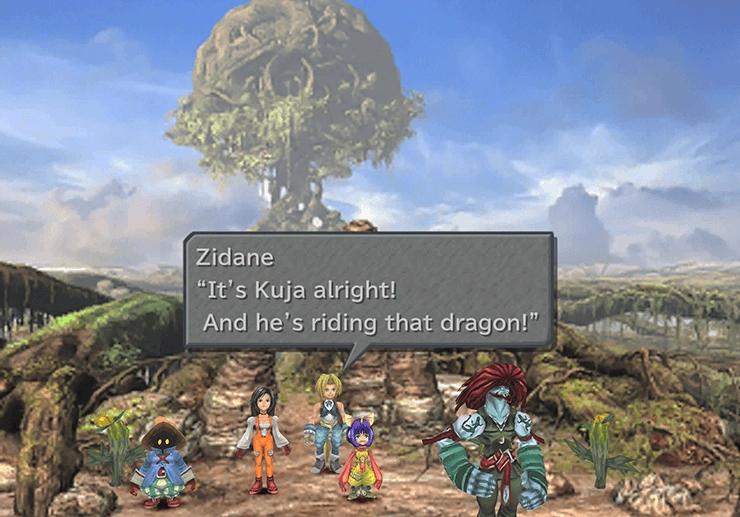
As much as I love FFIX’s traditional fantasy atmosphere, what really fascinates me about its story is how it eventually ventures into science fiction. We discover that Gaia, the world we’ve spent most of the game exploring, is inextricably connected to another world known as Terra.
Terra is a dying planet whose civilization sought to survive by assimilating other worlds. An attempted fusion with Gaia failed, leaving Terra inside Gaia. Garland is responsible for trying to complete that process, and his solution involves manipulating the very thing that allows life to continue: the cycle of souls.
The Iifa Tree interferes with Gaia’s natural cycle, preventing its souls from returning to the planet’s crystal and allowing Terra’s souls to take their place. The displaced souls are expelled as the Mist covering the continent. That Mist fuels airships, breeds monsters, and is exploited to manufacture Black Mages. The wars it helps perpetuate are beneficial to Garland, whose objective is to gradually replace Gaia’s life with Terra’s.3
I think that’s an absolutely fascinating premise. What appears at the beginning of the adventure to be a strange environmental phenomenon turns out to be connected to practically everything happening in the world. There are some similarities to FFVII’s Lifestream, particularly in the idea that life energy returns to the planet and is exploited by others for their own purposes.
I also find it interesting how IX uses crystals. As I mentioned in my FFII review, the elemental crystals were central to I, III, IV, and V. IX gives them a different kind of significance. Although there are crystals associated with the summoning of Alexander, much of the adventure doesn’t revolve around protecting four elemental crystals. Instead, the crystal represents the origin of life itself. The story eventually leads us back through the memories of the world to that origin.
In a sense, it takes one of the franchise’s oldest concepts and asks a much more fundamental question about it. Rather than merely being powerful magical objects that the heroes need to protect, the crystals are intimately connected to what it means for anything to exist.
Vivi and the Meaning of Life
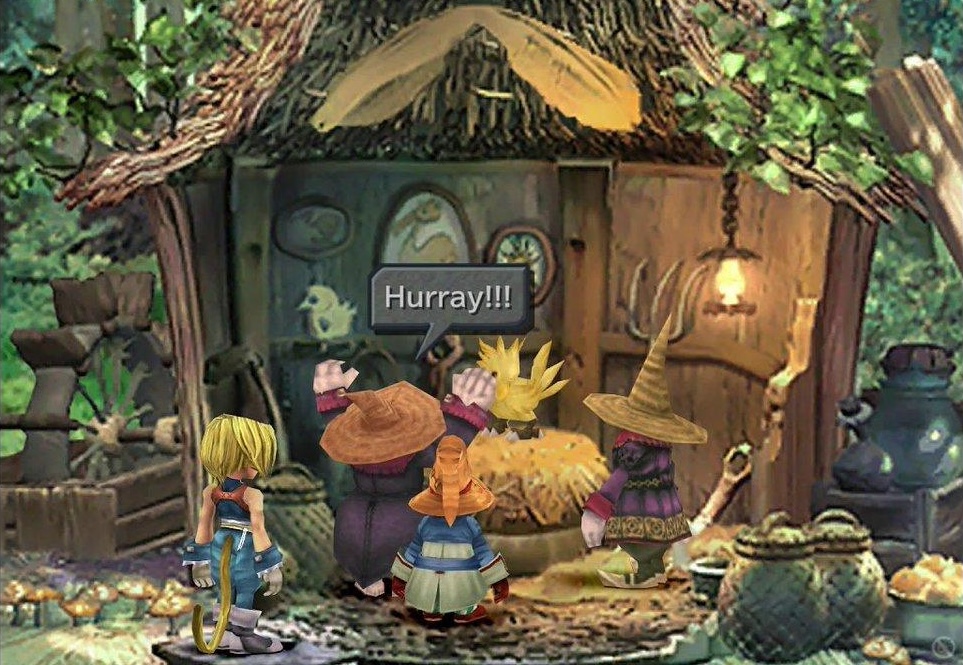
For me, Vivi is the character who most effectively communicates what the story is about.
We eventually discover that he’s a prototype of the manufactured Black Mages that have been used as weapons by Alexandria. His appearance, which is such a wonderful homage to the Black Mages from the original Final Fantasy, takes on an entirely different significance once we understand what he actually is.
What I find particularly heartbreaking is that Vivi doesn’t know how much time he has. At the Black Mage Village, he learns that the other Black Mages eventually stop moving. They don’t necessarily understand death in the way that we do, but they’re beginning to experience the grief associated with losing their friends. Vivi may be different from the other Black Mages, but that doesn’t mean he can escape mortality.
It’s interesting how many questions the game raises through such a small, unassuming character. Is he less of a person because he was manufactured rather than born in the conventional sense? Does the purpose for which he was created determine what he has to become? And how does he make sense of his own existence when he knows it might end at any moment?
I particularly appreciate that the game doesn’t give him some convenient solution that allows him to live forever. Instead, his journey is about coming to terms with his own mortality and finding meaning in the time he has.
Hironobu Sakaguchi spoke about this theme in an interview celebrating the game’s twentieth anniversary. He connected his interest in the cycle of life and death to experiences including the death of his mother, the birth of his daughter, and the loss of a close friend. He also singled out Vivi as a character through whom he felt the theme had been communicated particularly well.4
That really doesn’t surprise me. I think Vivi’s story is one of the most beautiful things in the entire franchise, and the fact that it manages to be so moving without even giving him a conventional human face is a testament to the writing, music, and animation.
Zidane and Kuja: Two Angels of Death
Zidane’s story eventually becomes quite similar to Vivi’s in some respects. He discovers that he, too, was created for a particular purpose. Garland intended him to replace Kuja as an Angel of Death, bringing about the destruction necessary for Terra’s eventual restoration.
Kuja, fearing that Zidane would eventually surpass him, kidnapped him as a child and abandoned him on Gaia. Zidane was subsequently taken in by Baku and grew up among the members of Tantalus, unaware of his origins.
I find the resemblance to Final Fantasy IV particularly interesting. In the expanded account of Golbez’s past in the 3D remake of IV, Golbez abandons his infant brother Cecil after falling under Zemus’s influence. While the circumstances and motivations aren’t identical, both stories involve a future antagonist abandoning a young boy who grows up unaware of his origins and eventually becomes his adversary. I don’t know if that particular parallel was deliberate, but it’s one I find quite neat.
What I particularly love about Zidane is how the revelation affects him. The guy who has spent practically the entire game encouraging others and telling them they don’t have to face their problems alone suddenly finds himself incapable of accepting their help. It’s one of the few occasions where we see the genuinely optimistic Zidane fall apart.
And that’s where You’re Not Alone! comes in. One by one, the people he has helped throughout the adventure come to his aid. Whatever Garland intended him to be, Zidane has become someone whose friends care about him. His identity has been shaped by the relationships he has developed, not simply by the purpose for which he was created.
Kuja, on the other hand, reacts very differently upon discovering that Garland has placed a limit on his lifespan. He has spent so much of his existence pursuing power and attempting to escape Garland’s control, only to learn that he cannot escape death. There’s a rather interesting parallel here with Xande from FFIII, who also struggles with the idea of mortality. Unlike Vivi, Kuja can’t accept that the world should continue to exist after his death.
I think the contrast between those three characters is an absolutely brilliant way of exploring the same theme from different perspectives. Vivi learns to appreciate life despite its brevity, Zidane chooses what to do with his life regardless of his origins, and Kuja initially believes that his own mortality renders everything else meaningless.
Necron: The One Thing I Would Change
If there’s anything that would make me reconsider giving Final Fantasy IX a perfect score, it’s the final boss.
I’ve mentioned in my reviews of FFIII and IV that I’m not particularly fond of the series’ tendency to replace the villain we’ve spent much of the adventure confronting with another antagonist near the end. Having recently replayed FFIII’s Pixel Remaster, I’ve noticed that there are at least a couple of references to the Cloud of Darkness before we finally encounter Xande. Even if I don’t particularly like how that final confrontation was handled, there is some degree of foreshadowing.
With Necron, I can’t help feeling that the game takes things a little too far.
We’ve spent the entire adventure gradually uncovering Kuja’s origins, watching him manipulate Brahne, and eventually discovering the reason for his desperate attempt to destroy the crystal. The conflict with Kuja is directly connected to Vivi’s struggle with mortality and Zidane’s discovery of his origins. The stage is set for an absolutely fantastic conclusion.
We defeat Trance Kuja, he unleashes one last powerful attack, and then all of a sudden we’re fighting Necron.
Who the hell is this guy?
I understand the thematic significance. Necron represents death and interprets Kuja’s fear of mortality as evidence that living beings would be better off not existing at all. Defeating him represents a rejection of that idea. I don’t think the character is entirely without purpose; I just don’t think the game adequately establishes him as an actual presence before the final battle.
Personally, I would have preferred the game to conclude with Kuja. Perhaps after defeating his Trance form, we could have fought him one last time as his power spiralled out of control. That would have allowed us to explore the same themes without having to introduce another entity at the very last moment. And if Square really wanted to include Necron, I would have appreciated some earlier references to establish what he was.
It’s a criticism I’ve had for years, and it’s probably the only aspect of the story I would really want to change. Fortunately, everything else the game accomplishes more than makes up for it.
A Beautiful Ending
I love that Zidane returns to the Iifa Tree to help Kuja, even after everything Kuja has done. It’s consistent with the person we’ve come to know throughout the game, and I think it’s particularly significant considering the role Kuja played in his childhood. Zidane doesn’t allow that history to prevent him from showing compassion.
And then there’s Vivi. The epilogue introduces us to several little Black Mages who identify themselves as Vivi’s sons. We never see Vivi himself, and the narration strongly implies that his time has come to an end. The game doesn’t explicitly explain how his children came into existence, but I like the idea that, despite having been created as a weapon, Vivi was able to leave behind something of himself.
I find that portion of the ending incredibly emotional. Vivi’s life was relatively brief, but he lived it, formed friendships, and made an impact on those around him. It’s exactly what he’d spent so much of the adventure wondering whether he would be able to do.
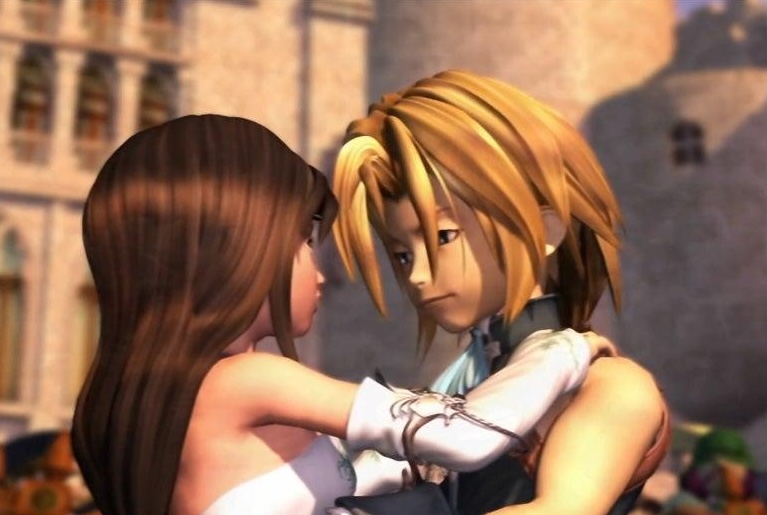
The return to Alexandria and the performance of I Want to Be Your Canary are a beautiful way to bring everything full circle. And the moment the supposedly absent Zidane reveals himself on stage, followed by Garnet rushing down to embrace him, is probably one of my favourite endings in Final Fantasy.
I have a particular fondness for the ending of FFIV because of everything Cecil and Rosa went through, but I think the ending of IX is every bit as satisfying. It’s joyful and bittersweet at the same time, and having Melodies of Life accompany the closing credits makes it all the more memorable.
Conclusion: A Celebration of Everything That Came Before
Looking back at Final Fantasy IX, I find it difficult to think of another entry that so successfully combines all the things I appreciate about the franchise. The world has the charm and sense of adventure I associate with the early games, the characters have distinct identities and abilities like those in IV, and the story explores questions that are every bit as interesting as those found in VI and VII.
What I especially appreciate is that the game doesn’t rely on its references to the earlier entries. It takes those familiar elements and does something interesting with them. Vivi is considerably more than a tribute to the Black Mage from FFI, Garland is more than a familiar name, and the crystals are given a significance that goes beyond their traditional role in the franchise.
It’s also a game where the individual elements complement one another wonderfully. The art direction, music, character development, battle system, and world-building all feel like they belong together. Despite dealing with some rather bleak subject matter, the game retains a warmth and sense of humour that I find enormously appealing.
The sudden appearance of Necron is something I would have preferred to see handled differently, but much like my criticism of Shadow’s ending in FFVI, it doesn’t outweigh everything the game does right. I don’t think a perfect score means that I can’t find a single thing to criticize. It means that, taken as a whole, the game is about as good as I could reasonably hope for.
Final Fantasy VII may currently occupy the top spot in my personal rankings, but IX is right up there with IV and VI. In some respects, I would argue that it’s the most representative of what Final Fantasy means to me. If someone wanted to know why I fell in love with this franchise in the first place, this would be one of the games I’d point them toward.
It’s a beautiful game, and one of the finest RPGs I’ve ever played.
Final Rating: 5/5
Perfect Masterpiece: A Beautiful Celebration of Final Fantasy
| Category | Rating |
|---|---|
| Story | 5/5 |
| Characters | 5/5 |
| Combat and Gameplay | 5/5 |
| Character Progression System | 5/5 |
| World and Exploration | 5/5 |
| Graphics (Original PlayStation) | 5/5 |
| Music | 5/5 |
| Historical Significance | 5/5 |
| Overall Rating | 5/5 |
-
Interview with Square, March 2000, an English translation of the contemporary Famitsu interview with Hironobu Sakaguchi. ↩︎
-
The Final Fantasy IX allusions guide catalogues many of the game’s callbacks. See also the Invincible and Doga and Unei entries. Some thematic parallels are my own interpretations rather than confirmed developer intentions. ↩︎
-
See Iifa Tree, Crystal, and Mist for further details on the relationship between Gaia and Terra and the cycle of souls. ↩︎
-
Famitsu: Final Fantasy IX twentieth-anniversary interview with Hironobu Sakaguchi, republished in July 2025 (Japanese). ↩︎