
Final Fantasy VIII - Ambitious ideas, uneven execution
Final Fantasy VIII is a strange game for me to discuss. It has an excellent soundtrack, one of the best minigames Square has ever created, an interesting setting, and a character progression system unlike anything the franchise had attempted before. However, it’s also a game whose story has frustrated me for years.
In many respects, FFVIII reminds me of Final Fantasy II. Both followed highly successful predecessors and, rather than simply refining what had already worked, took considerable risks with some of the fundamental mechanics of an RPG. FFII abandoned conventional character levels, while FFVIII introduced the concept of junctioning magic to attributes. Neither approach was without its problems, but I appreciate that Square was willing to experiment.
Released in 1999 for the original PlayStation, FFVIII had the unenviable task of following what had become the franchise’s biggest international success. Rather than giving us another FFVII, Square introduced more realistically proportioned characters, a military academy setting, a greater emphasis on romance, and a radically different approach to character development.
The result is a game I respect more than I necessarily enjoy. There are several aspects of FFVIII that I genuinely love, but I also think it has probably the weakest story of the Final Fantasy games I’ve reviewed so far.
My Experience with Final Fantasy VIII
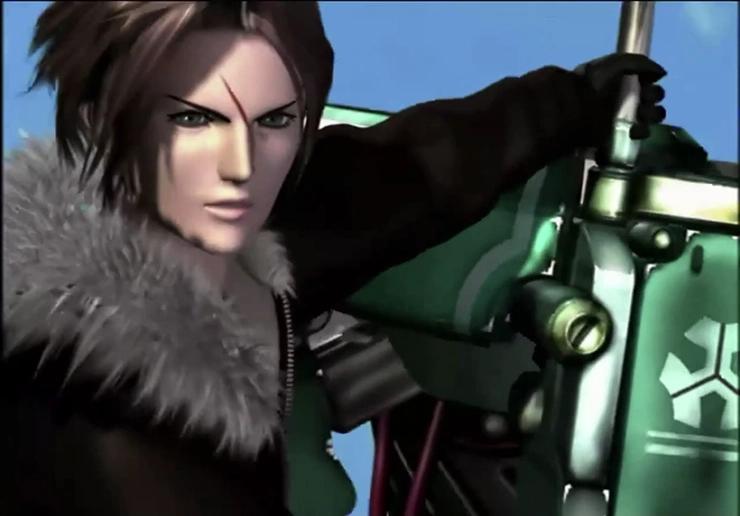
Unlike FFII, III, and V, I had the opportunity to experience FFVIII on its original hardware. I remember the excitement surrounding the game’s demos, particularly the sequence involving the SeeD assault on Dollet. The presentation was impressive for the time, and the move away from FFVII’s somewhat exaggerated polygonal character models was immediately noticeable.
For years, my three favourite Final Fantasy games were IV, VI, and IX, with VII and VIII generally occupying the remaining positions in my top five. My appreciation for FFVII has increased considerably since playing Remake and Rebirth, but FFVIII remains something of an outlier.
I’ve returned to it on several occasions, and one of my more memorable experiences involved spending an extraordinary amount of time attempting to obtain Squall’s ultimate weapon before the end of the first disc. Between playing Triple Triad, refining cards into items, and making sure I hadn’t levelled my characters beyond a certain point, it was a rather absurd amount of effort to obtain a weapon so early in the game.
But it was possible, and I enjoyed the challenge. That probably illustrates both the strengths and weaknesses of FFVIII’s gameplay better than anything else.
Balamb Garden: A Final Fantasy Military Academy
One aspect of FFVIII that I genuinely appreciate is its setting. Rather than beginning in a medieval kingdom or an industrial metropolis, the game introduces Balamb Garden, a military academy that trains young people to become elite mercenaries known as SeeD. Students receive instruction in combat and magic before participating in practical examinations, and graduates can be dispatched on missions for governments and other organizations.
Final Fantasy had previously featured military organizations such as Baron’s Red Wings, but there’s something particularly interesting about attending an institution where teenagers are trained to become professional soldiers for hire. The opening field examination at Dollet gives us a wonderful demonstration of what being a SeeD might entail.
There’s even a SeeD ranking system that determines your salary. Instead of receiving gil directly from every monster you defeat, you receive periodic payments based on Squall’s rank. It’s a clever way of incorporating the protagonists’ occupation into the gameplay.
Unfortunately, I don’t think Square did nearly enough with this premise. I would have loved to see optional missions where Squall and his companions were dispatched to different parts of the world to resolve conflicts, protect important individuals, or investigate unusual incidents. These could have provided additional opportunities to develop the characters and improve your SeeD rank through actual field operations, rather than relying so heavily on written tests and the main adventure.
As the conflict involving the sorceresses becomes more important, the game gradually moves away from the mercenary aspect. I think that’s unfortunate, because the military academy is one of the most interesting ideas Square introduced in FFVIII.
Squall Leonhart and the Main Cast
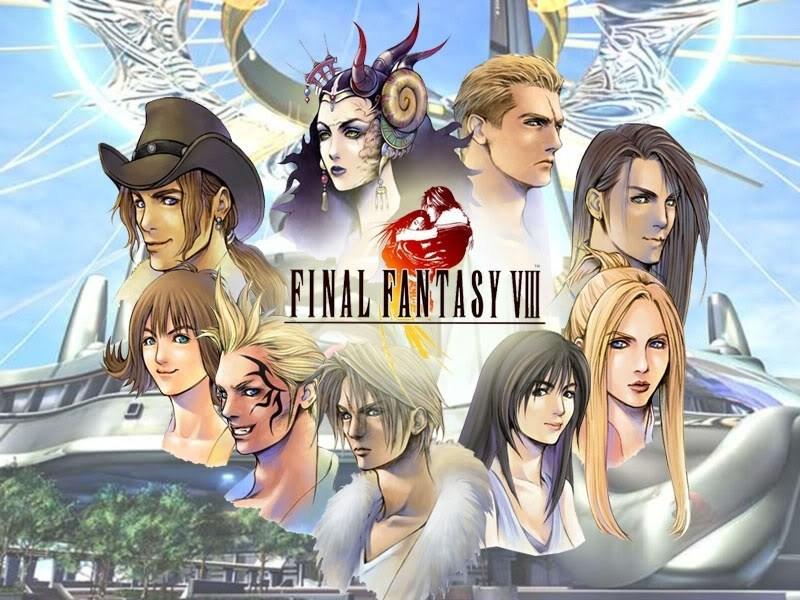
Squall is a seventeen-year-old student at Balamb Garden who generally prefers keeping his distance from others. His internal monologues reveal considerably more than he’s willing to express, and although I can understand why some players find him difficult to like, I think he’s an interesting protagonist.
Following Cloud Strife, Squall might seem like another attempt at creating a brooding, emotionally distant hero, but the two are different in important respects. Cloud’s behaviour is heavily influenced by his fragmented identity, whereas Squall is fundamentally afraid of becoming attached to people because he fears eventually losing them. His tendency to push others away is a defensive mechanism.
The supporting cast includes Quistis, a young instructor only slightly older than Squall; Zell, an energetic martial artist; Selphie, whose enthusiasm contrasts with Squall’s personality; and Irvine, a sharpshooter who presents himself as a confident ladies’ man. Then there’s Seifer, Squall’s rival, whose ambition is to become a sorceress’s knight. Both use gunblades, and their rivalry is established rather memorably during the opening cinematic, when a training exercise leaves each with a facial scar.
The person who has the greatest influence on Squall, however, is Rinoa Heartilly. Unlike the others, she’s a member of the Forest Owls, a resistance organization attempting to liberate Timber from Galbadian control. She’s considerably more outspoken and emotionally expressive than Squall, and their contrasting personalities provide the basis for the game’s romance. I occasionally find their interactions melodramatic, but Squall gradually learning to trust and accept others is a reasonably effective character arc.
From Mercenary Operations to a War Against Sorceresses
After completing a preliminary assignment involving Ifrit, Squall participates in the assault on Dollet and graduates as a SeeD. His first assignment takes him to Timber, where the party assists Rinoa and the Forest Owls against Galbadia. What begins as a relatively straightforward mercenary operation soon becomes a conflict involving Edea, a powerful sorceress allied with Galbadia.
The story also periodically shifts to the adventures of a Galbadian soldier named Laguna Loire and his companions, Kiros and Ward. Initially, these sequences seem almost entirely disconnected from Squall’s story, but I actually like the way the relationship between the two groups is gradually revealed. Laguna is a particularly likeable character whose personality provides a welcome contrast to Squall’s.
My problem is that what begins as an interesting adventure involving military academies, political conflicts, and sorceresses eventually becomes an increasingly convoluted story about memory loss, possession, time travel, and the compression of time itself. I’m not opposed to any of those concepts individually, but I don’t think the game brings them together particularly well.
Gameplay: Final Fantasy II All Over Again?
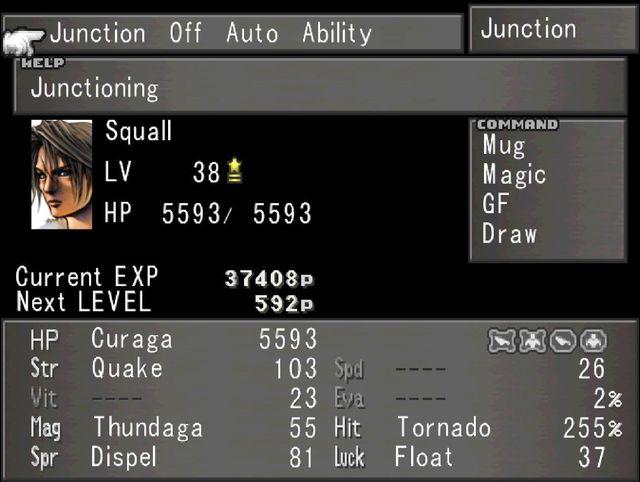
Much like FFII, Final Fantasy VIII represents a fundamental departure from the character progression mechanics that had become familiar to players. FFII did away with conventional experience levels altogether, while FFVIII retains them but makes them considerably less important than the magic and Guardian Forces you junction to your characters.
Rather than simply levelling up, purchasing new equipment, and learning stronger spells, you’re encouraged to obtain magic and use it to directly improve attributes such as Strength, HP, and Vitality. Magic can also be junctioned to elemental attacks and defenses, or used to protect against status ailments. The type of spell and the quantity you possess determine the effectiveness of the bonus.
I actually think the concept of junctioning is quite good. It gives players a tremendous amount of freedom, much like FFII’s progression system was intended to do. The difference is that FFVIII provides several different ways of obtaining the resources needed to develop your characters. My criticisms have more to do with the implementation than the underlying idea.
Drawing Magic and Developing Guardian Forces
Instead of learning spells conventionally, characters can use Draw to extract magic from enemies. Each character can stock up to one hundred units of a particular spell, and maximizing the benefits of junctioning encourages you to accumulate as much magic as possible.
Unfortunately, spending several turns drawing the same spell from an enemy isn’t particularly entertaining. There’s also the rather awkward situation where casting a spell can weaken your character if that spell is junctioned to an attribute. Why would I want to use my best magic if doing so makes me weaker?
Fortunately, drawing magic isn’t the only option. Guardian Forces, or GFs, earn Ability Points through combat and learn new abilities, including the means of refining items into magic. Equipping GFs also provides characters with access to commands and the ability to junction magic to different attributes. I like developing the GFs and discovering how their various abilities complement one another. Once you understand refinement, much of the tedious drawing can be avoided.
The system is remarkably easy to exploit, however. With the appropriate magic junctioned to your attributes, you can become incredibly powerful without gaining many levels at all.
Levelling Up Can Actually Make Things Harder
Many enemies scale with the party’s average level, so grinding for experience doesn’t necessarily give you the same advantage it would in earlier games. Depending on how effectively you’ve developed your GFs and junctioned magic, you might actually make the game easier by avoiding experience points.
I understand the idea of maintaining a consistent challenge, but discouraging players from levelling up seems rather counterintuitive for an RPG. It’s also reminiscent of my experience with FFII, where understanding the system could lead to some rather unconventional ways of developing your characters.
Getting Lion Heart on Disc One
One of the more entertaining things you can do with FFVIII’s progression system is obtain Squall’s ultimate weapon, Lion Heart, before the end of the first disc. The required materials are Adamantine, Dragon Fangs, and Pulse Ammo. Elnoyle cards can be refined into Energy Crystals and subsequently converted into Pulse Ammo, Grendels can drop Dragon Fangs depending on their level, and Adamantine can be obtained by refining the Minotaur card.
I remember spending hours playing Triple Triad and making sure my characters remained within the appropriate level range to obtain the necessary materials. The amusing thing is that you don’t even need the corresponding weapons magazine to craft Lion Heart, provided you’ve acquired everything required.
There’s something satisfying about understanding a game’s mechanics well enough to obtain equipment that would ordinarily be acquired much later. And while I question whether a system that encourages hours of card games and avoiding experience points is necessarily better than conventional progression, I can’t deny that I had fun doing it.
Combat and the Guardian Forces
Despite my reservations about some aspects of character progression, I think FFVIII’s gameplay is good. It retains the Active Time Battle system introduced in FFIV, and the character-specific Limit Breaks provide some welcome individuality. Squall’s Renzokuken involves timed button presses, Zell’s Duel uses button combinations reminiscent of Sabin’s Blitz, Irvine uses different ammunition, Rinoa has abilities involving Angelo, Quistis learns Blue Magic, and Selphie has her Slot command.
One thing I found interesting about the GFs was the absence of Ramuh, the familiar lightning-associated summon. Shiva, Ifrit, Bahamut, Leviathan, and Odin all return, but Ramuh is replaced by Quezacotl, a large birdlike creature. There are also some interesting newcomers, including Diablos, Brothers, Cerberus, and Doomtrain. Apparently, after giving Sabin the ability to suplex a supernatural train in FFVI, Square decided it was time to let us summon one.
Tonberry, Cactuar, and Eden offer additional variety, although I wish some GFs were easier to discover. Several must be drawn from particular bosses, making them easy to overlook if you don’t check what an enemy has available.
And then there are the summon animations.
Good grief, some of them take forever.
I appreciate how impressive they were in 1999, but after watching the same animation twenty or thirty times, the novelty wears off. There’s also the Boost ability, which on the original PlayStation involved holding Select and repeatedly pressing Square to increase a summon’s power, stopping whenever the warning symbol appeared or risk having your accumulated boost reset. Amusing the first few times, considerably less so after a while.
The Remastered edition’s three-times speed option helps, but I still wish there were a dedicated option to skip the animations entirely.
Triple Triad: One of the Best Minigames Square Ever Created
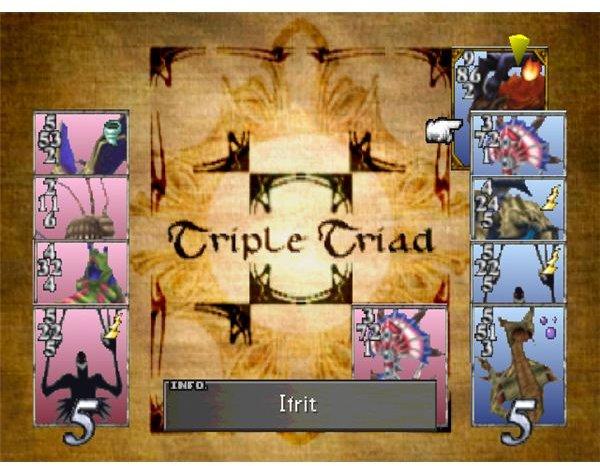
If there’s one aspect of Final Fantasy VIII that I absolutely love, it’s Triple Triad. It’s probably my favourite minigame in the entire franchise.
The premise is simple: two players place cards on a three-by-three grid, with numerical values on each side of the cards determining whether adjacent cards are captured. The player controlling the most cards at the end wins. Regional rules such as Same and Plus add considerable strategic depth, while other rules introduce elemental effects or force you to use randomly selected cards.
I absolutely hate the Random rule. What’s the point of assembling a collection of powerful cards if I can’t choose which ones to use?
What makes Triple Triad particularly impressive is that it isn’t merely a distraction from the main adventure. Card Mod allows you to convert cards into items, which can then be refined into magic or materials needed for weapon upgrades. Playing cards can make your party substantially more powerful, as my attempt to acquire Lion Heart demonstrates.
A Missed Opportunity?
I’ve always wondered why Square didn’t do more with Triple Triad as a standalone game. Matches are quick, the rules are easy to understand, and there’s an enormous selection of recognizable characters and creatures from across the franchise that could be incorporated into a dedicated release.
Of course, Square eventually introduced Triple Triad to FFXIV and offered a mobile version through the Final Fantasy Portal app, although the latter was discontinued in 2024. The 2025 collaboration between Final Fantasy and Magic: The Gathering also demonstrates the potential of the franchise in the collectible card game space. Personally, I’d love a permanent standalone Triple Triad game.
The Queen of Cards and Obscure Side Quests
As much as I enjoy Triple Triad, some of its associated side quests are absurdly obscure. The Queen of Cards quest involves deliberately losing particular rare cards to her so that her father can create new ones. Losing MiniMog, for instance, eventually leads to the creation of the Kiros card. You then have to find the NPC possessing the new card, while keeping track of the Queen’s movements between regions.
It brings me back to the question I raised about chocobo breeding in FFVII: How exactly was the average player supposed to figure all this out without a strategy guide?
I appreciate secrets, but there’s a difference between rewarding exploration and expecting players to deliberately lose valuable cards without clearly understanding the consequences. Still, Triple Triad remains one of the best aspects of FFVIII, and arguably more enjoyable than certain portions of the main adventure.
Graphics and Presentation
FFVIII was an enormous improvement over FFVII in terms of its field character models. The more realistically proportioned characters, detailed pre-rendered backgrounds, and spectacular full-motion video sequences made it one of the most impressive-looking PlayStation RPGs of its time. The opening duel between Squall and Seifer remains one of my favourite introductions to a game from that era.
Balamb Garden itself is a wonderfully distinctive location, with its futuristic architecture, classrooms, dormitories, and training facilities giving it the appearance of a functioning institution. Deling City, Fishermans Horizon, Winhill, and the futuristic city of Esthar provide considerable visual variety.
The Remastered edition improves the character models, but the comparatively blurry pre-rendered backgrounds can make the presentation feel inconsistent. The sharper characters occasionally look rather out of place against their surroundings. Nevertheless, I think the original game’s presentation was a tremendous accomplishment in 1999.
Music: Another Outstanding Nobuo Uematsu Soundtrack
If there’s one area where I have very few complaints about FFVIII, it’s the music. I wouldn’t rank the complete soundtrack above FFVII’s, but several compositions are among my favourites in the franchise.
Liberi Fatali, with its Latin choral vocals and dramatic orchestration, is an extraordinary accompaniment to the opening cinematic. Then there’s The Man with the Machine Gun, the energetic battle theme associated with Laguna and his companions. It’s quite different from Squall’s regular battle theme and perfectly suits Laguna’s more upbeat personality. If I had to choose two favourite tracks from FFVIII, those would probably be the ones.
The Landing and the Original Demo Music
I remember an early PlayStation demo using a different composition during the assault on Dollet, generally referred to as Raid on Dollet. It sounded remarkably similar to music from the 1996 action film The Rock, particularly the work associated with Hans Zimmer and Nick Glennie-Smith. It was subsequently replaced by The Landing in the finished game.
There’s been speculation that the change was related to the resemblance, although I’m not aware of definitive confirmation of legal action. It’s not quite the same as the situation involving Vanilla Ice’s Ice Ice Baby and Queen and David Bowie’s Under Pressure, but the similarities are certainly amusing. I liked the demo music, and I think The Landing is an excellent replacement.
Eyes on Me
Another significant composition is Eyes on Me, performed by Faye Wong. Whereas FFVII’s One-Winged Angel used synthesized choral vocals, FFVIII introduced a fully produced pop ballad that is directly connected to the story.
Some of my friends in high school weren’t particularly enthusiastic about FFVIII, and this song was one of the things they criticized. Personally, I thought it was perfectly fine. It’s sentimental, but considering the emphasis on romance, it fits the game. I also remember hearing it performed by vocalist Xiao at a Final Fantasy concert, which was a nice reminder of the longevity of Uematsu’s music.
Other standouts include Force Your Way, Don’t Be Afraid, Balamb GARDEN, and the wonderfully peaceful Fisherman’s Horizon. I also appreciate Premonition, Maybe I’m a Lion, The Castle, and the dramatic final battle theme, The Extreme. Whatever my criticisms of the game itself, the soundtrack is excellent.
Story Discussion — Spoilers Ahead
The Orphanage Revelation: One Coincidence Too Many
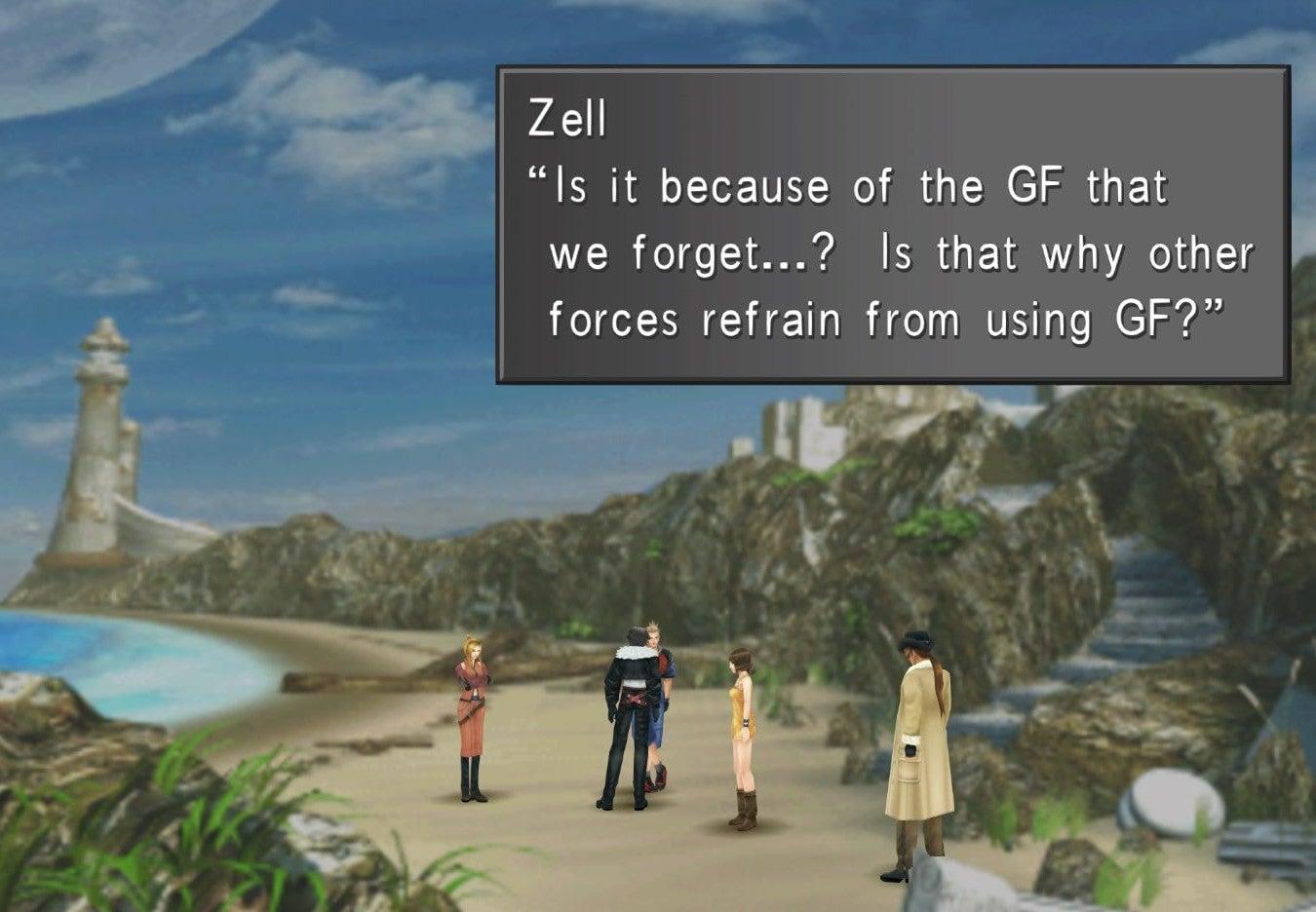
Now we come to probably my biggest criticism of FFVIII. During the adventure, we discover that Squall, Quistis, Zell, Selphie, Irvine, and Seifer all grew up together in an orphanage operated by Edea. They also knew Ellone, whom Squall called Sis. Most have forgotten their childhoods because of their use of Guardian Forces, with Irvine being the notable exception because he hadn’t relied on GFs in the same way.
I find the entire explanation rather silly. It’s one thing to reveal that a couple of characters share a history, but having almost the entire party turn out to have grown up together, only for them to conveniently forget about it, is an enormous contrivance.
There are references to the possible side effects of GFs earlier in the game, so the idea doesn’t come entirely out of nowhere. Nevertheless, if the use of Guardian Forces can cause such significant memory loss, shouldn’t that have been a much more serious concern for the organization training these students? Wouldn’t anyone notice that large portions of their childhood memories were disappearing?
Personally, I would have limited the orphanage connection to Squall and Ellone. Their relationship already provides a reasonable explanation for Squall’s fear of abandonment. Quistis could have been an exceptionally talented instructor, Zell could have grown up with his adoptive family, Selphie could have followed her own path through Trabia Garden, and Irvine could simply have been a sharpshooter from Galbadia Garden.
Characters can become friends because of the experiences they share during an adventure. They don’t all need to have known one another as children.
Laguna, Ellone, and the Generational Romance
One aspect of the story that I genuinely like is the connection between Squall’s adventure and Laguna’s past. Laguna develops feelings for Julia Heartilly, a pianist and aspiring singer, but circumstances separate them before their relationship has an opportunity to develop. He subsequently ends up in Winhill, where he becomes involved with Raine and helps care for Ellone.
Laguna eventually leaves to rescue Ellone, and his adventures lead him to Esthar. Meanwhile, Raine gives birth to Squall. Julia, the woman Laguna once loved, marries General Caraway and becomes Rinoa’s mother.
The romance between Squall and Rinoa consequently brings together the children of two people whose own relationship never had an opportunity to develop. It also gives Eyes on Me additional significance, as Julia wrote the song about her feelings for Laguna. Years later, it becomes associated with the relationship between their children.
Yes, it’s another rather extraordinary coincidence, but unlike the orphanage revelation, it feels appropriate within a story so heavily concerned with romance and destiny. It’s a beautiful concept and one of the better things FFVIII does with its narrative.
Edea, Ultimecia, and Time Compression
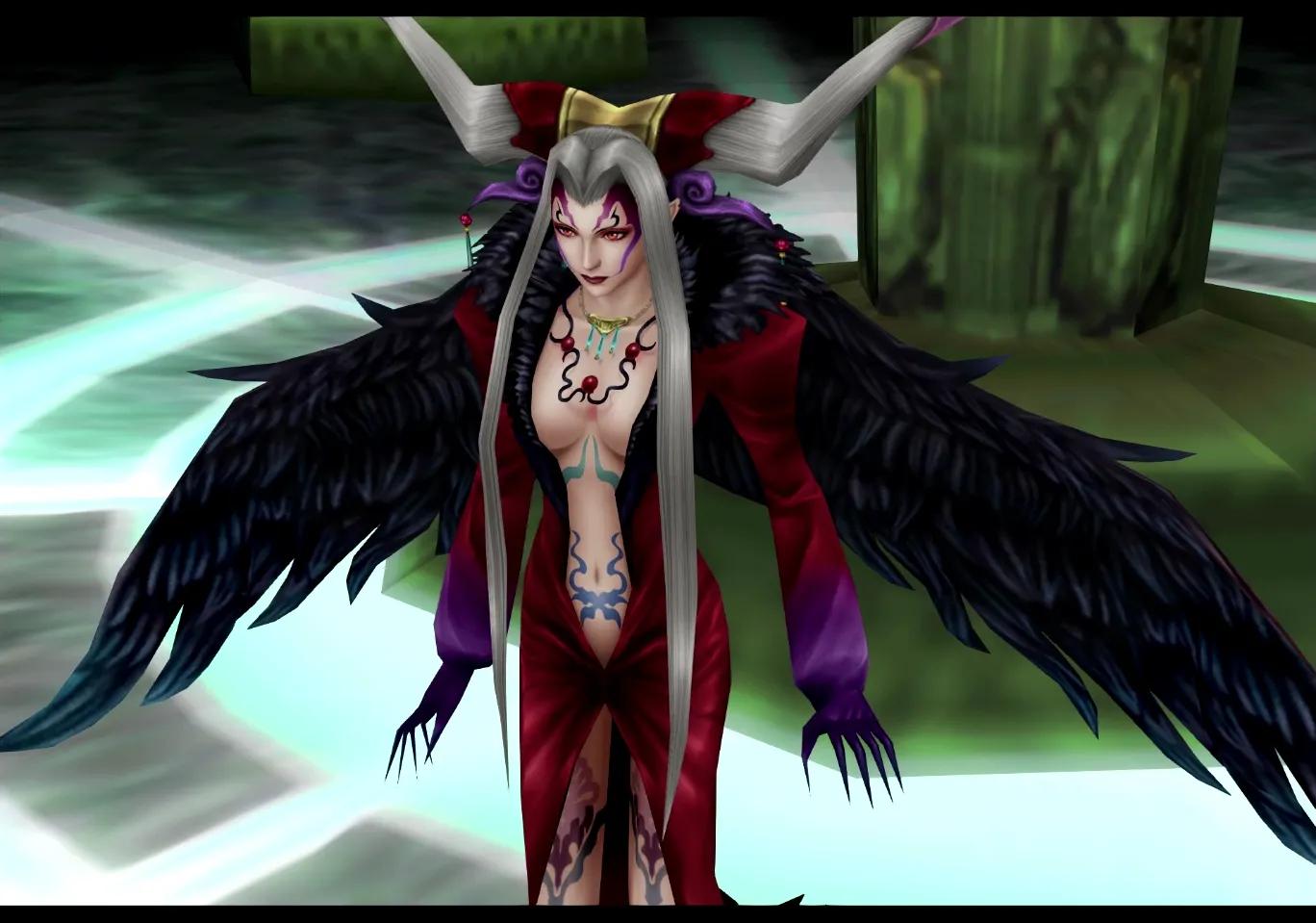
Initially, Edea is presented as the primary antagonist. We eventually discover that she’s being controlled by Ultimecia, a sorceress from the distant future. It’s somewhat reminiscent of Golbez and Zemus in FFIV, although Edea’s connection to the protagonists and the creation of SeeD gives the revelation a little more personal significance. The switch also occurs early enough that Ultimecia has more time to establish herself as the antagonist than some of the last-minute villains in earlier games.
Unfortunately, I find Ultimecia’s actual plan considerably more complicated than it needs to be. Using technology based on Ellone’s ability to send people’s consciousness into the past, she intends to compress different periods of time into a single existence over which she can exert control.
Why does compressing all of time solve her problem? What happens to ordinary people in the process? Why not simply attempt to prevent the creation of SeeD, the organization she fears will eventually defeat her?
I realize that time-travel stories tend to involve paradoxes. FFI already featured one involving Garland and the Four Fiends, but its basic premise was relatively easy to understand. FFVIII combines possession across time, consciousness transfer, and the merging of different historical periods. Complexity doesn’t necessarily make a story more interesting.
Personally, I would have preferred a straightforward story about a sorceress who attempts to manipulate the past through Ellone’s abilities to prevent the establishment of SeeD. The game already contains the foundation for that idea: Squall travels into the past and tells Edea about Garden and SeeD, contributing to the creation of the very organization Ultimecia fears.
That’s a perfectly good time-travel paradox. I don’t think it needed to become much more elaborate than that.
The Fan Theories: Is Squall Dead? Is Rinoa Ultimecia?
Perhaps the most famous FFVIII fan theory suggests that Squall dies when Edea strikes him with an ice projectile at the end of the first disc. Everything that follows is supposedly a dream or hallucination experienced as he dies. I find this rather unconvincing, as it seems like an attempt to explain every unusual storytelling decision by suggesting that none of it actually happened. Director Yoshinori Kitase has also rejected the theory.
The idea that Rinoa eventually becomes Ultimecia is considerably more interesting to me. Depending on the interpretation, Rinoa loses Squall, becomes increasingly isolated, and ultimately transforms into the sorceress the party confronts. Supporters point to thematic parallels and the symbolism associated with Griever. It would certainly create a tragic connection between the game’s romance and its central conflict.
However, it’s not established by the finished game. Kitase rejected the theory in 2017, though he later qualified his response regarding what other members of the writing team might have intended. I wouldn’t present it as canon, but I can understand why it has appealed to fans over the years.
The Ending: A Romance Across Time
Despite my criticisms, I actually like the ending. After defeating Ultimecia, Squall becomes separated from his companions and travels through different periods, eventually reaching Edea’s orphanage. The dying Ultimecia transfers her powers to Edea, and Squall tells her about Garden and SeeD, completing the time loop.
I find that aspect of the ending much more interesting than the elaborate explanation of time compression itself. Rinoa eventually reaches Squall, and the story concludes with the characters celebrating their victory at Balamb Garden. Squall, who initially avoided emotional attachments out of fear of abandonment, has learned to trust others and accept the possibility of loss. Whatever unanswered questions remain, the ending provides some satisfying emotional closure.
What I Would Change in a Final Fantasy VIII Remake
Given my criticisms of the Whispers and the changes to the narrative in FFVII Remake and Rebirth, it might seem odd that I would welcome substantial story changes in an FFVIII remake. However, I think VIII has considerably more room for improvement in that department.
I’d expand the military academy setting with optional SeeD missions and give the supporting characters more development. I’d reconsider the orphanage revelation, retaining Squall’s connection to Ellone without requiring almost everyone else to share the same history. If the psychological consequences of using GFs were retained, I’d explore them in greater detail. And I’d simplify Ultimecia’s plan without necessarily removing time travel from the story.
As for the gameplay, I would actually retain junctioning. The concept is interesting, and I don’t think it needs to be thrown away simply because drawing magic can be tedious. I’d improve magic acquisition, reconsider enemy level scaling, and provide an option to skip the lengthy Guardian Force animations. Naturally, I’d also love to see Triple Triad return with more cards and a less obscure collection system.
There’s a lot here worth preserving. I just think FFVIII would benefit from the kind of narrative overhaul that I wouldn’t necessarily want to see in a remake of FFVII.
Conclusion: A Game I Respect More Than I Love
Final Fantasy VIII is a good RPG with several excellent ideas. The military academy setting is fascinating, the junction system represents an ambitious departure from conventional character progression, and the combat is enjoyable despite some of my frustrations with the way GFs and magic are implemented. The presentation was impressive for its time, the soundtrack is fantastic, and Triple Triad remains one of the best minigames Square has ever created.
It’s the story that really holds the game back for me. I appreciate the relationship between Squall and Rinoa and the generational connections involving Laguna and Julia, but the orphanage revelation, Guardian Force-induced memory loss, and time compression are all things I wish had been handled differently. Of the games I’ve reviewed so far, I think VIII probably has the weakest story. I’d struggle to give that aspect of the game more than 2.5 out of 5.
Like FFII, it deserves recognition for attempting something different. I just find myself considerably more attached to FFII, despite its flaws. I have more affection for FFVIII’s gameplay than I do for much of its story, and that’s a rather unusual situation for me when discussing Final Fantasy.
I don’t regret playing FFVIII, and I’d be interested in seeing what Square could accomplish with a remake. But when I compare it with IV, VI, VII, or IX, it doesn’t come particularly close to the level of enjoyment I associate with those games.
I respect Square for experimenting with the formula. I just wish some of those experiments had worked a little better.
Final Rating: 3/5
Good: Ambitious Gameplay and Excellent Music, Undermined by a Weak Story
| Category | Rating |
|---|---|
| Story | 2.5/5 |
| Characters | 3.25/5 |
| Combat and Gameplay | 4/5 |
| Character Progression System | 3.75/5 |
| World and Exploration | 3.75/5 |
| Graphics (Original PlayStation) | 4.5/5 |
| Music | 4.75/5 |
| Historical Significance | 4/5 |
| Overall Rating | 3/5 |