
Final Fantasy VII - The game I didn’t realize was my favourite
Of all the Final Fantasy games I’ve discussed so far, Final Fantasy VII probably has the strangest history when it comes to my personal appreciation of the franchise.
For years, my top three consisted of Final Fantasy IV, VI, and IX, with IV and VI regularly competing for first place. VII and VIII would generally occupy the remaining positions in my top five. It wasn’t that I didn’t think FFVII was excellent; I simply preferred the more traditional fantasy settings of the earlier games.
Then something rather unexpected happened after I played Final Fantasy VII Remake and Rebirth. Despite having some fairly significant criticisms of the Remake project, those games made me rediscover just how much I loved the original. Having since played through it again, I would now confidently place it at the very top of my personal rankings.
Considering how much sentimental value I associate with FFIV and VI, that’s quite a statement.
My First Experience: Starting at the End
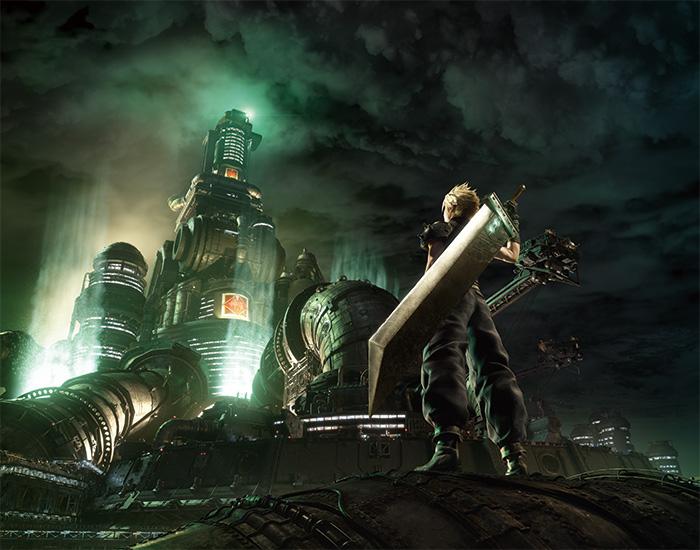
My introduction to Final Fantasy VII was rather unusual. I was in Grade 9 when I visited a friend’s house after school and watched him finish the game. So, before I even knew who Cloud was or why everyone was fighting Sephiroth, I’d already seen the final dungeon and the ending. I suppose you could say the game was completely spoiled for me, although I didn’t have enough context to understand most of what I was watching.
At the time, I didn’t own a PlayStation. My older brother would eventually buy a Sega Dreamcast, and we subsequently acquired an original PlayStation. I remember playing a small portion of FFVII without a memory card, which, needless to say, isn’t particularly conducive to making meaningful progress in an RPG. Once I finally had one, I played through the entire game.
I enjoyed it quite a bit, but the enormous cities, corporations, firearms, motorcycles, and advanced technology didn’t appeal to me quite as much as the castles and kingdoms of the earlier games. There was still plenty of fantasy in FFVII, of course, but its atmosphere was noticeably different. It would take quite a few years for my appreciation of that setting to change.
A Natural Evolution from Final Fantasy VI
Looking back at the franchise, I think FFVI serves as something of a bridge between the first five games and FFVII. Although the earlier entries occasionally incorporated science fiction, their worlds were predominantly inspired by traditional fantasy. FFVI introduced an industrialized civilization where magic had largely disappeared, and where the Gestahlian Empire was exploiting Espers to power its Magitek technology.
FFVII takes that concept considerably further. In place of a conventional empire, we have the Shinra Electric Power Company, a corporation that has discovered how to extract the planet’s life energy in the form of Mako. It uses that energy to power cities, machinery, and its military, all at the expense of the planet itself.
What makes Shinra particularly interesting is that it has essentially become a government unto itself. It controls entire cities, maintains its own armed forces, and has enough influence to dictate the lives of people across the planet. The contrast between the wealthy residents living above Midgar’s plates and the impoverished communities beneath them tells you quite a bit about how that society functions.
There’s something rather unsettling about the idea of a corporation becoming so powerful that entire populations are subordinate to its interests. And considering the environmental themes of the game, much of its underlying message remains relevant today.
Cloud Strife and AVALANCHE
The story begins with Cloud Strife, a mercenary claiming to be a former member of SOLDIER, Shinra’s elite military organization. He’s been hired by AVALANCHE to help destroy one of Midgar’s Mako reactors. Rather than spending twenty minutes explaining the state of the world, the game has you jump off a train, fight your way through Shinra’s security forces, plant a bomb, and escape before the reactor explodes. It’s a fantastic introduction.
I also find it interesting that AVALANCHE is effectively an ecoterrorist organization. Their motivations become considerably more sympathetic once you understand what Shinra is doing to the planet, but they are deliberately destroying critical infrastructure and potentially putting civilians in danger. I’m reminded somewhat of Tom Clancy’s Rainbow Six, which also features radical environmentalists willing to engage in acts of terrorism, albeit under very different circumstances and for very different ends.
What initially appears to be a relatively localized struggle between a corporation and a resistance movement gradually develops into something far more personal and ultimately existential. Shinra’s experiments, Cloud’s past, and the return of Sephiroth become intertwined without the original conflict ever feeling irrelevant.
An Exceptional Cast of Characters
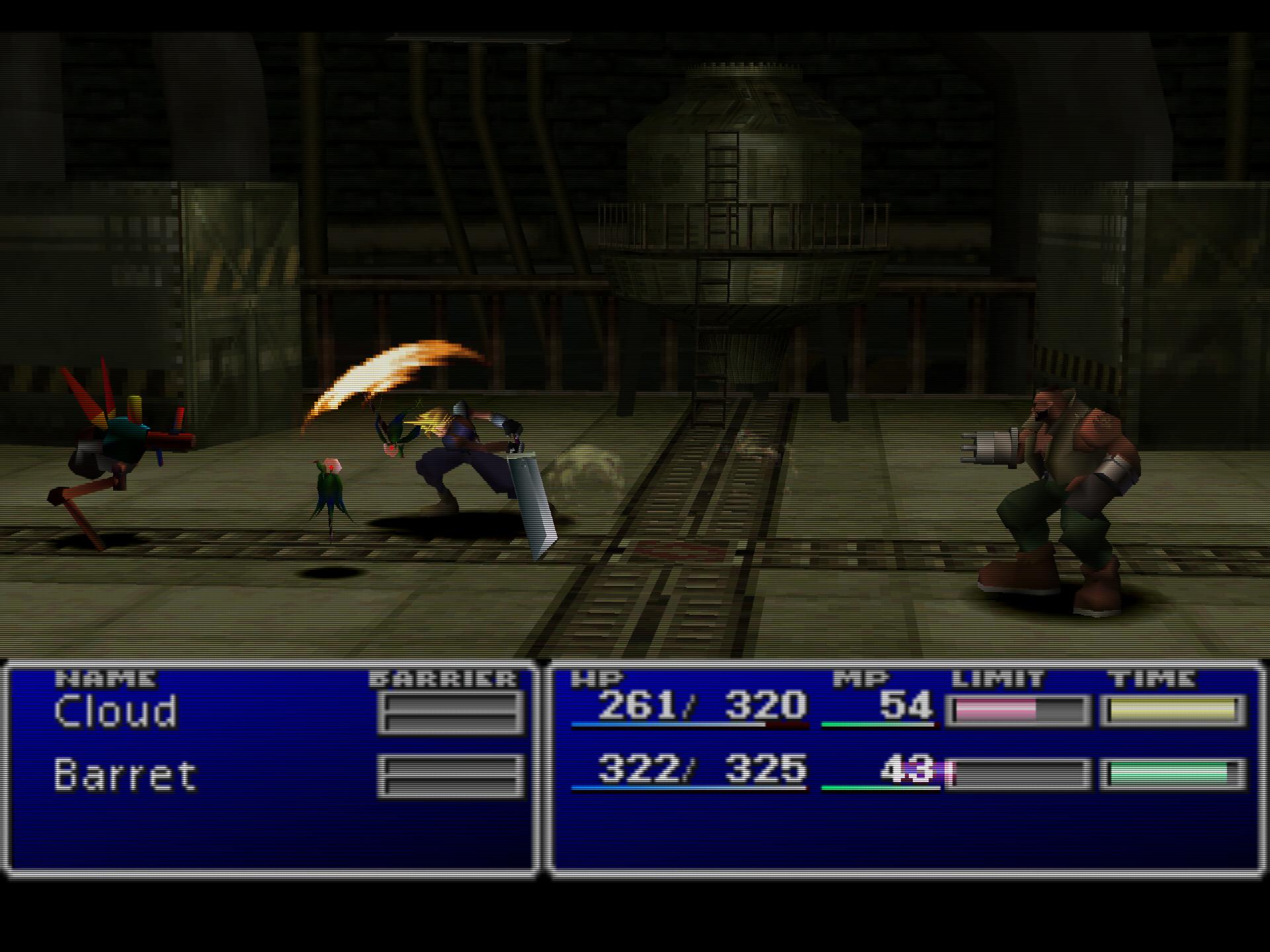
One of FFVII’s greatest strengths is its cast. Cloud initially comes across as an aloof mercenary who cares little for anything beyond his payment, but there is considerably more to him than that. Tifa Lockhart, his childhood acquaintance and a member of AVALANCHE, is one of my favourite characters in the franchise because of how instrumental she becomes to his story. Aerith Gainsborough, meanwhile, is playful, perceptive, and willing to challenge Cloud’s outwardly indifferent behaviour.
Barret’s passion for protecting the planet and his aggressive approach to doing so make him a particularly interesting member of the group. Red XIII has a wonderful story connected to Cosmo Canyon, while Yuffie’s obsession with Materia is responsible for one of the more entertaining optional adventures. Then there’s Cid Highwind, whose dreams of space exploration were frustrated by Shinra; Vincent, a former Turk with connections to some of the game’s darker revelations; and Cait Sith, whose loyalties are initially questionable.
I have tremendous affection for FFVI’s enormous ensemble, but I would argue that FFVII is more consistent in its development of the supporting characters. The smaller cast gives Square more opportunities to explore their relationships and motivations. Even characters who are optional, such as Vincent and Yuffie, have their own histories and additional story sequences. Of course, the relationships between Cloud, Tifa, and Aerith are especially important, and I’ll return to those in the spoiler discussion.
Gameplay: Materia, Limit Breaks, and Active Time Battle
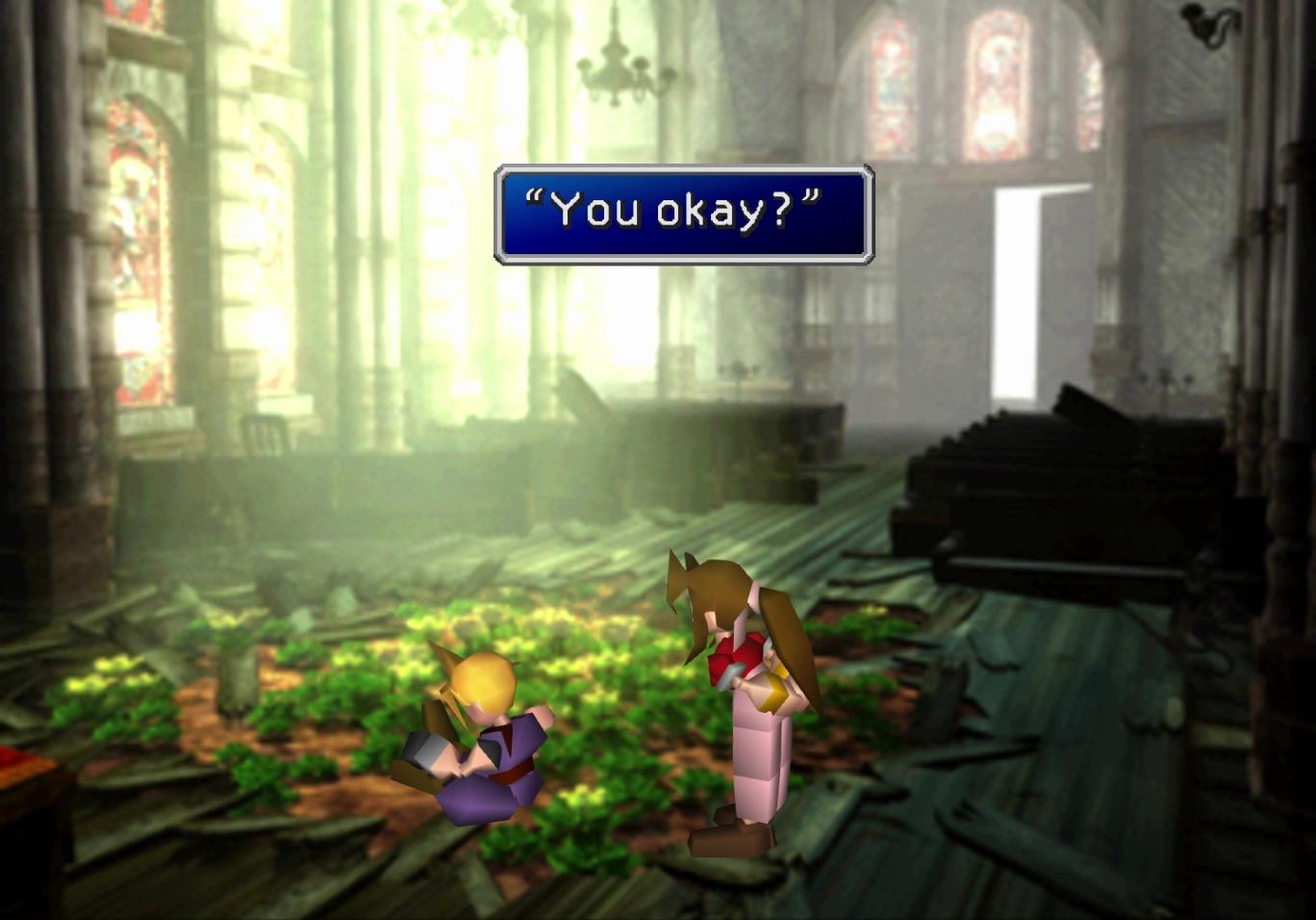
FFVII retains the Active Time Battle system introduced in FFIV, but its most significant innovation is Materia. In some respects, this feels like a natural evolution of the customization systems introduced in FFV and VI. Rather than permanently learning spells from Espers or acquiring abilities through jobs, characters equip crystallized Mako in their weapons and armour to gain access to magic, summons, and various commands.
What makes the system particularly interesting is Support Materia, which modifies the abilities of other Materia when placed in linked slots. All, for example, allows compatible spells to target multiple enemies or allies, while other combinations enable counterattacks or the absorption of HP and MP. As Materia gains AP, new abilities become available, giving the player a reason to develop their equipment as well as their characters.
The system is easy to understand without sacrificing depth. You can turn Cloud into a powerful spellcaster or give Tifa a greater role in supporting the party. As with FFVI, however, such flexibility can make the characters feel somewhat interchangeable later in the adventure. Their unique Limit Breaks help maintain some distinction between them.
I particularly like the Limit Break system. As characters sustain damage, their Limit gauges fill, eventually allowing them to unleash powerful special abilities. Some are offensive, while others offer healing or defensive benefits. Cloud’s Omnislash is probably the most recognizable, although I’ve always enjoyed Tifa’s combinations as well.
Overall, I think FFVII strikes an excellent balance between accessibility and depth. There is plenty of room for experimentation without the need to spend hours figuring out how the progression system actually works. And as much as I’ve come to appreciate the combat in Remake and Rebirth, I still have a tremendous amount of affection for traditional ATB combat.
Exploration, the Gold Saucer, and Optional Content
One of the things I appreciate about FFVII is the sheer amount of content that isn’t necessary to complete the story. The Gold Saucer alone contains chocobo racing, a battle arena, and numerous minigames. There are optional quests involving Yuffie and Vincent, and powerful superbosses such as Ruby Weapon and Emerald Weapon for players looking to test their understanding of the combat system.
There’s a good deal of satisfaction in gradually exploring the world beyond Midgar, especially once the Highwind opens up much more of it. You can finish the adventure without obtaining every piece of Materia or defeating every superboss, but if you want to spend another twenty or thirty hours experimenting with the game’s mechanics, there’s plenty to do.
My biggest complaint is that some of this content is unnecessarily obscure.
Chocobo Breeding: How Were We Supposed to Figure This Out?
I love the concept of breeding chocobos with different abilities. Some can cross rivers, others can traverse mountains, and eventually you can obtain a Gold Chocobo capable of reaching almost any location on the world map. Chocobo racing at the Gold Saucer ties into the breeding system, and your ultimate reward is access to the island containing Knights of the Round, one of the game’s most powerful summons.
But how the hell were players supposed to figure all of this out without a guide? You need particular chocobos, specific nuts, and potentially higher racing ranks. The Zeio Nut comes from Goblins on an island in the northeastern part of the world map, while the Carob Nut can be obtained from Vlakorados near Bone Village. I know the Chocobo Sage and the people at the farm provide hints, but there’s quite a difference between giving the player clues to solve an interesting puzzle and expecting them to piece together an entire breeding programme.
There was certainly something exciting about discovering secrets in RPGs before detailed guides were readily available on the internet. I just think Square occasionally took that philosophy a little too far.
Missable Items and Other Obscure Secrets
Another example is the Turtle’s Paradise side quest, which involves finding six promotional flyers scattered throughout the world and claiming a reward at the restaurant in Wutai. I’ve completed FFVII several times and still don’t believe I’ve ever finished that quest. One of those flyers can be permanently missed, and there are other rewards that require similar attention to detail.
Cait Sith’s ultimate weapon, HP Shout, is a particularly amusing example. You can obtain it from a locker on the 64th floor of the Shinra Building during your late-game return to Midgar. The story is pushing you toward a rather urgent objective, yet the game expects you to make a deliberate detour through the underground tunnels and revisit a locker you might not even remember examining earlier in the adventure. Miss the opportunity and that’s it.
FFVI has its share of hidden rewards, but something like the choice between the Ragnarok sword and Esper in Narshe feels more naturally discoverable through exploration. You can even exchange the sword for Lightbringer at the Coliseum, although, as I’ve mentioned before, I absolutely hate the automated combat in that arena.
FFVII’s optional content is excellent overall. I just wish some of it were a little more transparent.
Graphics: Square’s Leap Into Three Dimensions
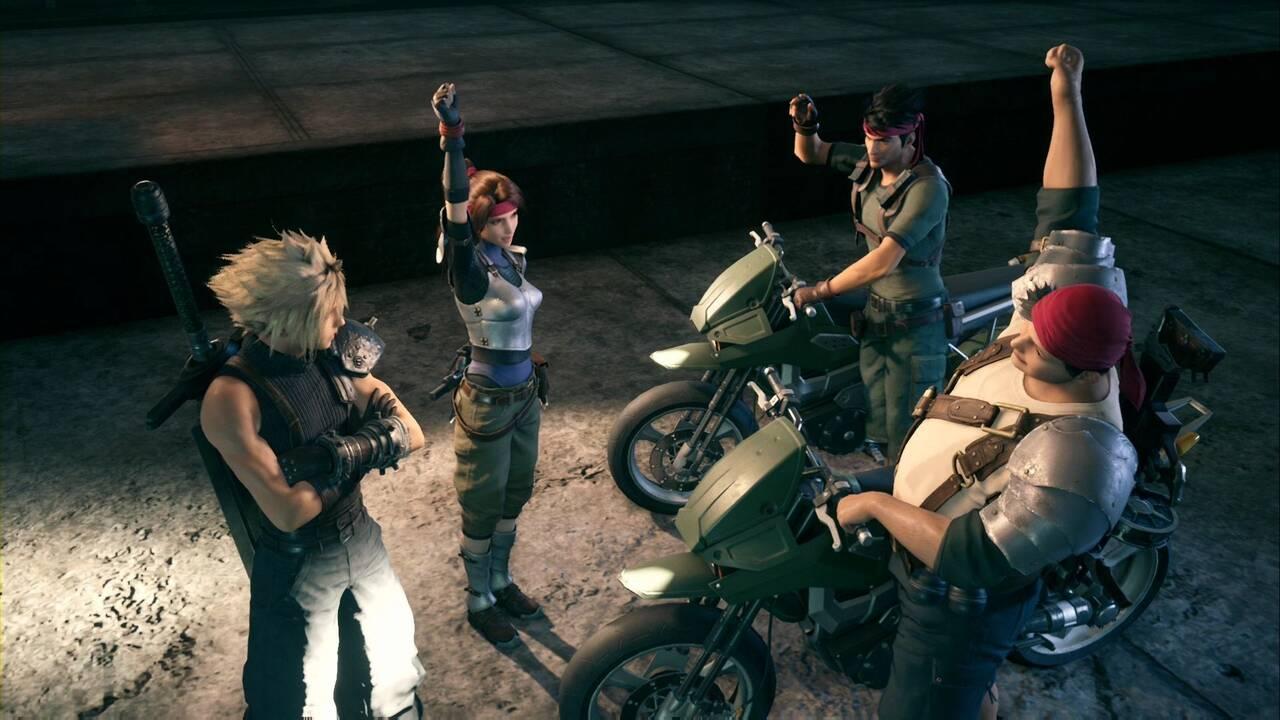
When FFVII arrived on the PlayStation in 1997, the transition from sprites to polygonal characters and pre-rendered backgrounds was an enormous technical leap for the franchise. The opening cinematic, with the camera pulling away from Aerith to reveal the sheer scale of Midgar before focusing on the train carrying Cloud, remains one of my favourite introductions to a video game.
The environments still have a great deal of character. Midgar’s dark industrial architecture feels appropriately oppressive, while places such as Cosmo Canyon, the Gold Saucer, Nibelheim, and the Forgotten Capital each have a distinctive visual identity. The pre-rendered backgrounds and full-motion video sequences helped Square translate the storytelling ambitions of FFVI into three dimensions.
Of course, the polygonal character models haven’t aged nearly as gracefully as FFVI’s sprite work. Watching Cloud run around with enormous hands and very little in the way of facial features is rather amusing today, but I still find the original presentation charming. It’s worth remembering how impressive all of this was in 1997.
Music: Possibly the Best Soundtrack in the Franchise
As much as I’ve praised Nobuo Uematsu’s work on FFIV, V, and VI, I genuinely think FFVII might be his finest overall soundtrack. The original release spans four CDs, and there are an enormous number of compositions that I still enjoy listening to today.
Opening – Bombing Mission is a wonderful example of the music and visuals working together. The quiet opening gradually builds into something far more dramatic as we see the full scale of Midgar and transition into the first mission. I absolutely love Let the Battles Begin! and the boss theme, Fight On!, both of which have the kind of energy that makes even routine encounters enjoyable. I’m also particularly fond of FFVII’s rendition of the victory fanfare.
Tifa’s Theme has a wonderfully gentle, nostalgic quality that suits her relationship with Cloud, while Aerith’s Theme is one of the most emotionally powerful pieces in the franchise, especially given its use during one of the story’s defining moments. Both are excellent examples of Uematsu’s ability to communicate something about a character through music.
And then, of course, there’s One-Winged Angel. The synthesized choir and elaborate orchestral arrangement make it feel completely different from the final boss themes of the earlier games. It’s not difficult to understand why it has become one of the most recognizable compositions in video game music.
I also love the unsettling energy of J-E-N-O-V-A, the distinctive sound of Cosmo Canyon, and the ominous atmosphere of Those Chosen by the Planet. Main Theme of Final Fantasy VII is one of Uematsu’s finest overworld compositions, while Lifestream, The Great Warrior, and Interrupted by Fireworks demonstrate just how much emotional range the soundtrack has.
I remember reading about Uematsu wanting to approach the music differently from his earlier work, although I’d have to revisit those interviews before commenting on exactly what he intended. Whatever his approach, the results speak for themselves. FFVI comes very close, and I still have a particular fondness for Battle at the Big Bridge from FFV, but if I had to choose one complete Final Fantasy soundtrack, I think VII would win.
Story Discussion — Spoilers Ahead
From Ecoterrorism to Saving the Planet
One of the things I appreciate about Sephiroth as an antagonist is that he remains a presence throughout most of the adventure. Following the events at the Shinra Building, the pursuit of Sephiroth takes precedence over AVALANCHE’s original objectives, but the corporation’s activities remain integral to the story. Even when Sephiroth isn’t physically present, his influence is felt through Cloud’s memories, the Jenova experiments, and the increasingly disturbing revelations about Nibelheim.
Unlike some of the earlier games, FFVII doesn’t spend most of the adventure developing a villain only to replace them with someone else near the end. By the time we confront Sephiroth, there’s a very personal reason for Cloud and the others to stop him, beyond his plans for the planet.
Cloud Strife: A Protagonist Who Doesn’t Know Who He Is
Cloud’s character arc is something I appreciate much more today than I did during my original playthrough. He initially presents himself as a confident former SOLDIER operative who served alongside Sephiroth at Nibelheim. As the story progresses, inconsistencies emerge in his account. Tifa recognizes certain details but knows that things didn’t happen quite the way Cloud remembers them, and Sephiroth exploits his uncertainty.
We eventually learn that Cloud was never a member of SOLDIER. He was an ordinary Shinra infantryman who had failed to achieve his dream. What I find particularly interesting is that his failure doesn’t necessarily reflect a lack of physical ability or courage. At Nibelheim, he managed to overcome Sephiroth despite being an ordinary infantryman. I see his inability to withstand the psychological demands of SOLDIER’s enhancement process, and the subsequent trauma of Hojo’s experiments, as much more important to understanding his character.
Following the Nibelheim incident, Cloud and Zack were subjected to Hojo’s experiments. After Zack’s death, Cloud’s fragmented memories, Jenova’s influence, and his desire to become the person he had always imagined himself to be contributed to the creation of the persona we encounter at the beginning of the game.
What makes this revelation so effective is that Cloud’s memories aren’t entirely fabricated. He really was at Nibelheim. He witnessed many of the things he describes, but his role was different from what he believed. It’s much more interesting than a conventional story about a protagonist suffering from amnesia. In many respects, the truth about Cloud is more impressive than the identity he constructed for himself.
Tifa and the Real Cloud
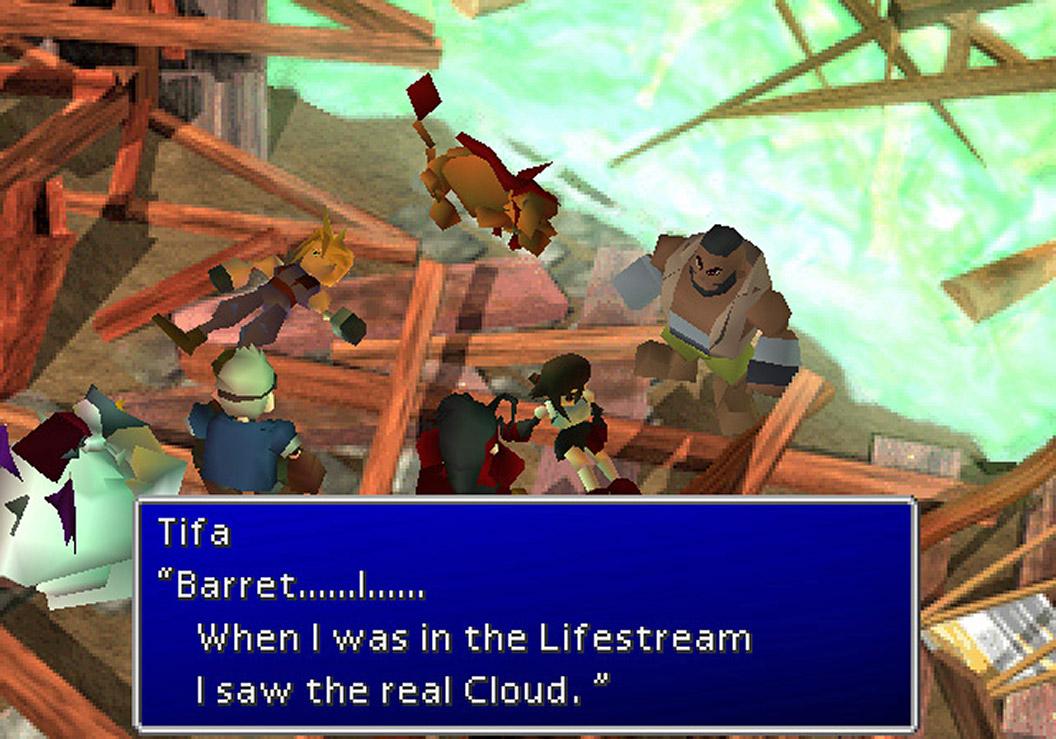
Tifa is central to Cloud’s recovery. She knew him as a socially awkward boy in Nibelheim who struggled to fit in with the other children. He wanted to become someone extraordinary, in part because he believed it would make him worthy of her attention. When he returned as an ordinary infantryman, he was too ashamed to reveal himself to her.
There’s something painfully human about that. Cloud wasn’t simply looking to become a powerful warrior; he wanted recognition and acceptance. The events in the Lifestream allow Tifa to help him reconstruct his memories and accept who he really is. His value isn’t dependent on having become a SOLDIER. He’s someone who failed, suffered, and made mistakes, but also someone who demonstrated tremendous courage when it mattered most.
For me, it’s difficult to imagine FFVII’s story working without Tifa. She’s every bit as instrumental to the resolution of Cloud’s personal story as Cloud himself.
Aerith, Tifa, and Cloud’s Two Identities
I’ve always had a particular interpretation of the relationships between Cloud, Aerith, and Tifa. The Cloud we encounter during the earlier portions of FFVII, whose identity has been constructed partly from Zack’s experiences, has a wonderful dynamic with Aerith. She’s outgoing and playful, and brings out a different side of his personality. I can certainly understand why people prefer that pairing.
However, once Cloud recovers his memories and begins accepting his actual identity, I find Tifa to be a more natural romantic partner. Not simply because they knew each other as children, but because she understands the person he was before everything went wrong and helps him become that person again.
Put simply, I think the constructed Cloud is particularly compatible with Aerith, while the real Cloud is more compatible with Tifa. That’s not to suggest his feelings for either woman are invalid, or that every player should interpret the relationships the same way. The game leaves some flexibility in how those relationships develop, but personally, I’ve always preferred Cloud and Tifa.
Aerith’s Death
It’s worth remembering just how shocking Aerith’s death was when FFVII was originally released. She isn’t a temporary guest character; she’s one of the central members of the party, whose personality, abilities, and relationship with Cloud have become integral to the experience. And then Sephiroth kills her at the Forgotten Capital.
There is no convenient resurrection, no secret item or elaborate side quest that allows you to reverse what happened. Earlier Final Fantasy games had already featured permanent character deaths, including FFII and Galuf in FFV, but that doesn’t diminish the effectiveness of the scene. Aerith continues to influence events through the Lifestream, yet the player is forced to continue the adventure without her. It’s one of the game’s boldest decisions, and it’s precisely why I have mixed feelings about how Rebirth handles the same event.
The Original Ending
After Sephiroth’s defeat, Meteor is still approaching the planet. Holy initially appears insufficient to stop the catastrophe, and it’s only through the intervention of the Lifestream that Meteor is repelled. I think this is a beautiful conclusion to the environmental themes established at the very beginning of the game. Shinra has spent years exploiting the planet’s life energy, Sephiroth attempts to appropriate it for himself, and ultimately the planet intervenes to prevent its own destruction.
The final scene, five hundred years later, shows Red XIII and his descendants looking out over the ruins of Midgar, now overgrown with vegetation. The original ending leaves humanity’s fate somewhat ambiguous. Subsequent entries in the Compilation provide additional context, but I appreciate the questions the original scene raises about what it means to save the planet. It doesn’t necessarily mean preserving the world exactly as it was.
Shinra Archaeology Cut: Revisiting the Original
I recently completed another playthrough of FFVII using the Shinra Archaeology Cut mod, which offers a revised translation and attempts to restore content removed during development. I particularly enjoyed some of the additions involving Wall Market and the Honeybee Inn, which provide context for events and conversations that I remember being rather abrupt in the original.
I find projects like this fascinating, although it’s worth remembering that some of the restored material involves reconstruction and interpretation on the part of the mod’s developers. I wouldn’t necessarily recommend it for a first playthrough, but for someone who’s already familiar with FFVII, it’s a worthwhile way of revisiting the game and seeing how much material was left on the cutting-room floor.
Remake and Rebirth: Rediscovering Final Fantasy VII
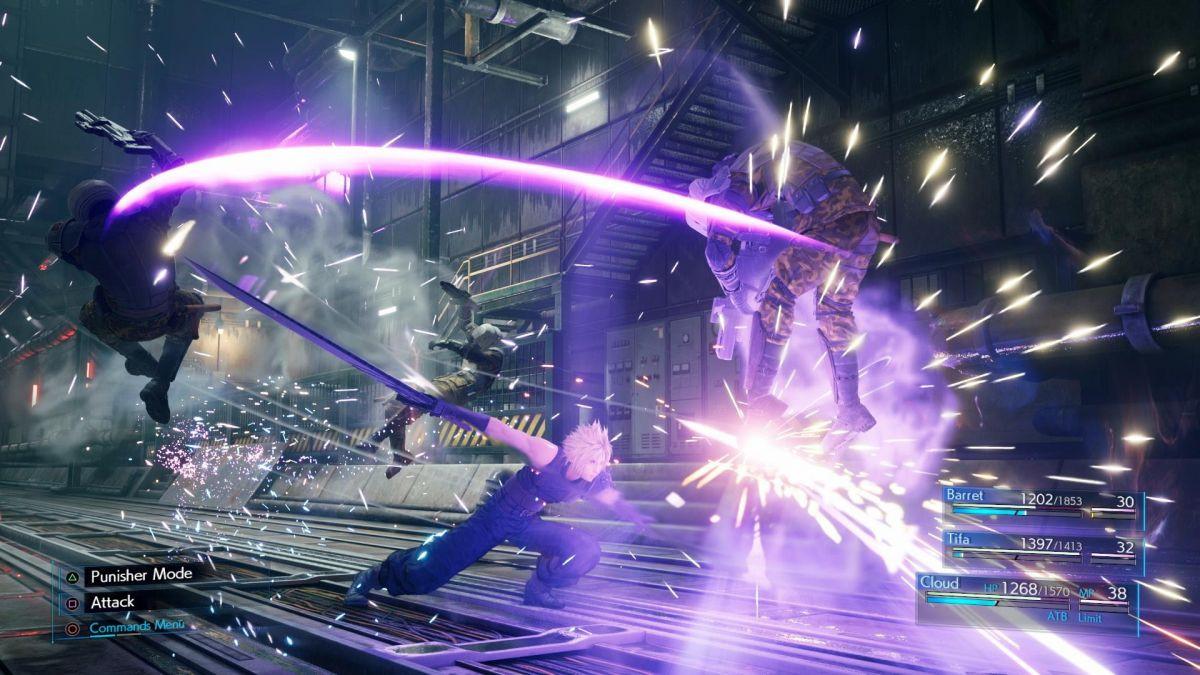
Ironically enough, my first experience with FFVII Remake was anything but positive. I bought it on Steam, reached the Scorpion Sentinel, and found myself becoming increasingly frustrated with the emphasis on pressure and staggering enemies. It reminded me too much of FFXIII, a game I played for only a few hours before giving up because I couldn’t get into its combat system. I barely managed to beat the Scorpion Sentinel and stopped playing shortly afterward.
I eventually purchased a PlayStation 5, partly because I wanted to give Remake another chance and play Rebirth, but also because I wanted to play Ratchet & Clank: Rift Apart, a series I’d like to revisit in a separate set of reviews. This time, once I became comfortable switching between characters, using their abilities, and managing the ATB gauges, something clicked.
I still prefer traditional ATB combat in many circumstances, but the hybrid system is much more enjoyable than I initially gave it credit for. There’s considerably more strategy involved than simply mashing an attack button, and Rebirth expands upon the system with synergy abilities and additional combat options. Neither game replaces the original for me, but they helped me appreciate its world and characters in ways I hadn’t previously considered.
What Remake Improved
Perhaps the most obvious improvement is the additional attention given to Biggs, Wedge, and Jessie. Their deaths in the original were tragic in principle, but I never felt particularly attached to them. We simply hadn’t spent enough time getting to know them. Remake does a fantastic job of addressing that, particularly with Jessie and the additional scenes involving her family.
That’s the sort of expansion I wanted from the Remake project. The towns feel more alive, the supporting characters have more opportunities to interact with one another, and events that occupied a relatively short portion of the original adventure receive considerably more attention. In many respects, the developers have improved upon the original’s characterization and presentation.
The Whispers and Schrödinger’s Aerith
My biggest criticism of Remake and Rebirth involves the Whispers and the decision to introduce the possibility of changing fate. Initially, I was open to the idea. If Square wanted to create a version of FFVII where events could unfold differently, why not embrace it? I would have been perfectly willing to see characters survive who had originally died, provided the story explored the consequences of those changes.
The problem is that so far, the games seem reluctant to fully commit to that concept. I’d estimate that roughly two-thirds to seventy percent of the major story beats remain recognizable, albeit with considerable additions. Yet we’re also given an increasingly elaborate narrative involving alternate possibilities and the Whispers, suggesting that practically anything could happen without necessarily allowing the most important events to change.
Nowhere is this more apparent than with Aerith. Rebirth presents a deliberately ambiguous version of her death in which Cloud appears to have both saved her and failed to save her. Is she alive in another world? Is Cloud imagining her? Are we witnessing different versions of the same event? I started thinking of it as Schrödinger’s Aerith.
I understand how this could relate to Cloud’s inability to accept loss and the original game’s exploration of unreliable memories. Nevertheless, I find it frustrating that one of the most emotionally significant moments in the original has become the subject of speculation over what actually happened. I would have been happy with a faithful recreation of Aerith’s death, and I would have welcomed a genuinely different narrative in which she survived. What I find less satisfying is the attempt to have it both ways.
Perhaps the final installment will put all of this into a context that makes the decisions more meaningful. Based on what I’ve played so far, however, it’s easily my biggest criticism of the project.
Hard Mode and Postgame Progression
Another frustration involves the restrictions imposed by Hard Mode. I enjoy difficult optional encounters, but I don’t particularly like being prohibited from using items. There’s a difference between fighting a more challenging enemy and being prevented from using basic mechanics that were available throughout the adventure.
Although Remake and Rebirth don’t require Hard Mode to reach their respective level caps of 50 and 70, certain manuscripts, rewards, and completion challenges are tied to it. I’d much rather have access to those challenges without the restrictions on consumables. It’s a relatively minor complaint compared with my issues with the story, but one that has discouraged me from pursuing some of the additional content.
Conclusion: Rediscovering a Masterpiece
It still amuses me that it took nearly three decades for Final Fantasy VII to become my favourite entry in the franchise. I was always more attached to the settings of the earlier games, and it was only after playing Remake and Rebirth that I came to fully appreciate everything the original accomplished.
Cloud’s fragmented identity and eventual recovery make for one of the most compelling character arcs in Final Fantasy. Tifa and Aerith are both excellent characters, the supporting cast is memorable, and the transition from a struggle against Shinra to the conflict with Sephiroth is remarkably effective. The soundtrack might be Uematsu’s finest, and the Materia system remains tremendously enjoyable.
The game isn’t without flaws. Some side quests and missable items are unnecessarily obscure, the character models have aged noticeably, and I remain frustrated by several of the creative decisions made in the Remake project. None of that diminishes what the original means to me.
FFIV will always be special as the first Final Fantasy I completed, and FFVI as the first one I owned, thanks to my older brother. FFIX remains among my favourites as well. But at this particular moment, VII occupies the top spot.
I don’t think giving a game a perfect score means it has no flaws. It means that, considering the experience as a whole, those shortcomings do very little to diminish my appreciation. And ironically enough, despite their own flaws, I have Remake and Rebirth to thank for helping me rediscover just how wonderful the original really was.
Final Rating: 5/5
Masterpiece: My Favourite Final Fantasy
| Category | Rating |
|---|---|
| Story | 5/5 |
| Characters | 5/5 |
| Combat and Gameplay | 5/5 |
| Character Progression System | 4.75/5 |
| World and Exploration | 5/5 |
| Graphics (Original PlayStation) | 4.75/5 |
| Music | 5/5 |
| Historical Significance | 5/5 |
| Overall Rating | 5/5 |