
Final Fantasy - Where It All Began
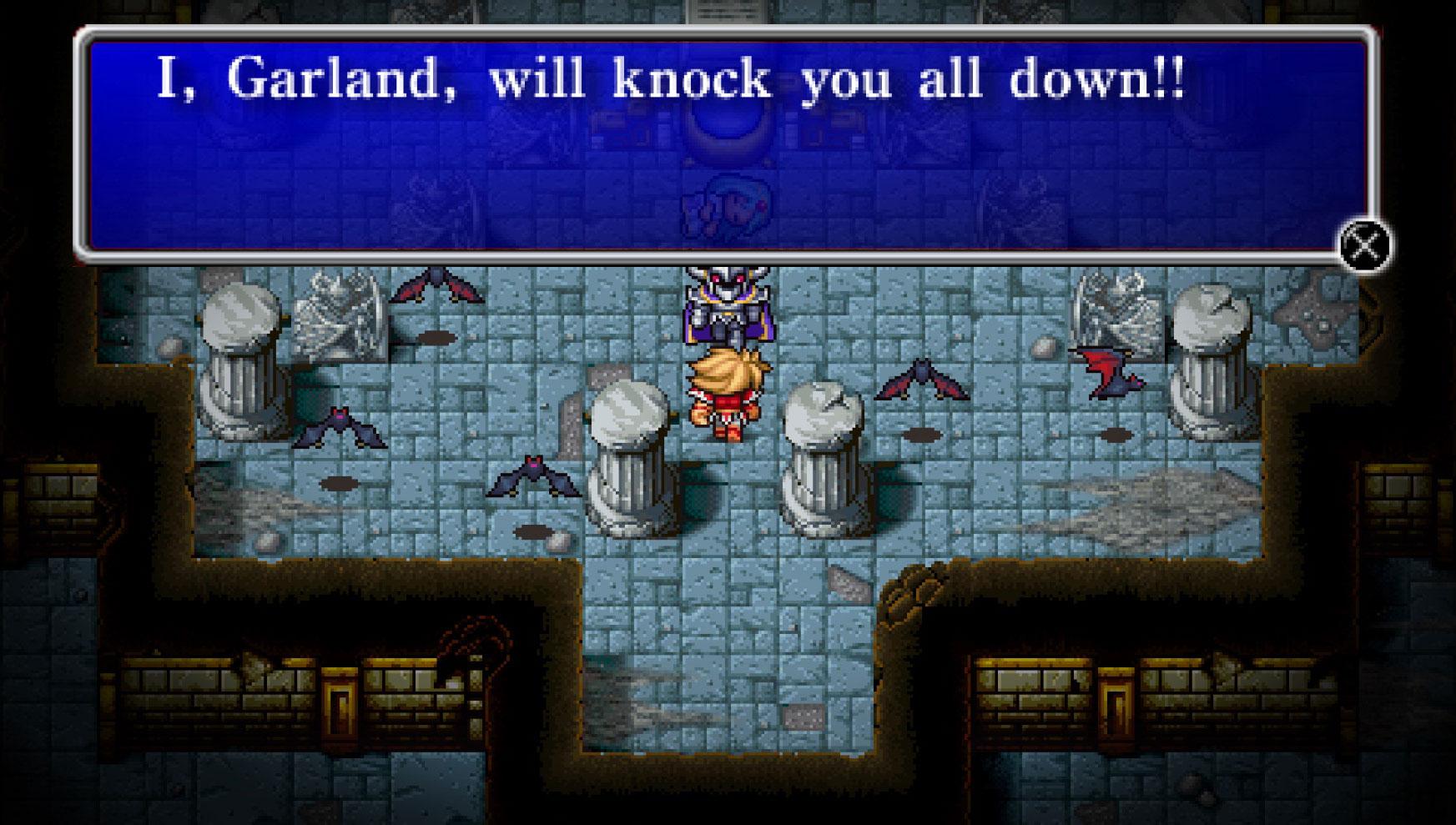
I recently came across a post in one of the Final Fantasy communities on Reddit, where a fellow Redditor had shared his reviews of the games in the franchise. Although I felt his promise of a scientific or objective approach was a little ambitious, the post inspired me to write a series of retrospectives on the Final Fantasy games I’ve played over the years.
As it turned out, his reviews divided each game into categories such as music, battles, bosses, story, characters, and world design. Each category received a few sentences of commentary and a numerical score, followed by an overall rating out of 10.
Nevertheless, the post got me thinking. Despite having played through a substantial portion of the Final Fantasy franchise, I’ve never really sat down and written proper reviews of most of the games. I’ve certainly discussed them online, sometimes at considerable length, and I have no shortage of opinions about individual entries. But I’ve never made much of an effort to organize those thoughts into something resembling a comprehensive retrospective.
So I figured, why not?
Rather than trying to assign some supposedly objective numerical value to every aspect of these games, I’d rather discuss what I enjoyed, what I didn’t, and how my impressions have changed over the years.
And what better place to begin than with the original Final Fantasy?
My First Experience with Final Fantasy
Despite being a longtime fan of the franchise, I didn’t actually experience the original Final Fantasy until considerably later.
I vaguely remember seeing someone play it when I was younger, though I can’t recall the circumstances or whether I even knew what I was watching. I might also have spent a little time with the Game Boy Advance version included in Final Fantasy I & II: Dawn of Souls, but I don’t believe I ever made much progress.
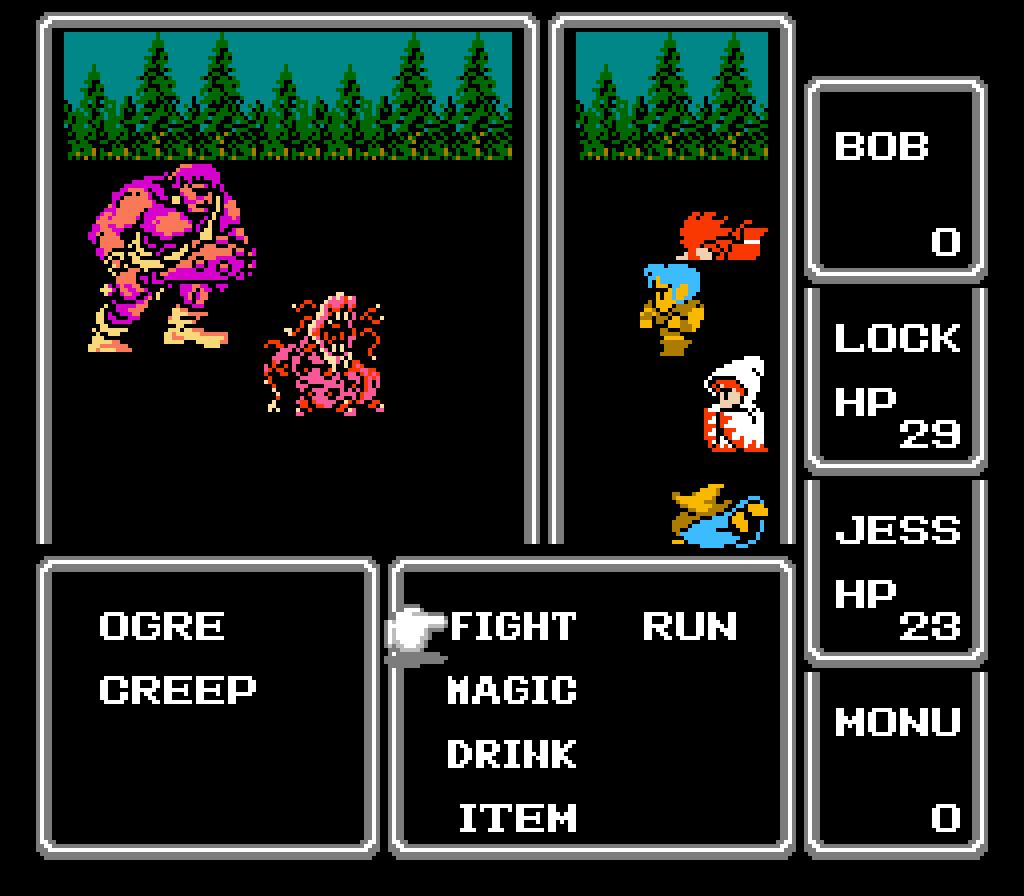
The first version I actually completed was the mobile release that predated the Pixel Remaster release1. More specifically, it was the mobile remake based on the PlayStation Portable’s Final Fantasy 20th Anniversary Edition, which itself built upon earlier enhanced versions of the game.
This is an important distinction because, although the underlying adventure is essentially the same, the version I played was a little different from the original NES release. It featured updated graphics, rearranged music, a more forgiving progression system, and additional content that wasn’t present in the original game.
Among these additions were the Soul of Chaos bonus dungeons, originally introduced in the Game Boy Advance version, and the Labyrinth of Time, which was added in the PSP edition. These extras were included in the original iPhone release, although the some content was missing from the Android version.
At the time, I thought of it as simply playing the original Final Fantasy with a more modern presentation.
While I enjoyed the experience, I find the game somewhat difficult to evaluate today. Not because it’s bad, but because subsequent games have improved upon, expanded, or completely reinvented so much of what it introduced.
It’s a little like going back to the original Dragon Quest after having experienced decades of RPGs influenced by it.
You can appreciate its historical significance while simultaneously recognizing how basic some of its mechanics and storytelling have become by modern standards. That doesn’t mean we should overlook its shortcomings, but I think there’s something to be said for considering the context in which it was originally released.
Final Fantasy was released for the Japanese Famicom in December 1987, with the North American NES release following in 1990. When I consider what Square accomplished with the hardware available at the time, I think there’s quite a bit worth appreciating.
Four Warriors of Light and a World in Peril
The premise of Final Fantasy is about as straightforward as you can get.
The world is gradually falling into ruin because the four elemental crystals have lost their light. The earth is decaying, the seas are becoming increasingly dangerous, and the natural balance of the world has been disrupted by four powerful creatures known as the Four Fiends.
However, an ancient prophecy speaks of four Warriors of Light who will appear carrying darkened crystals and restore their power. Naturally, those warriors are the characters you control.
Unlike later Final Fantasy games, there are no established protagonists with elaborate personal histories, complicated relationships, or individual character arcs. Your four characters are essentially blank slates. You assign them names, select their classes, and send them off on their adventure. There’s no equivalent of Cecil, Terra, Cloud, or Zidane here. The Warriors of Light don’t really have personalities beyond whatever the player imagines for them.
In some respects, I think this is both a strength and a weakness.
On the one hand, it gives the game a certain degree of freedom. You’re not playing through the story of an established protagonist; you’re creating your own party of adventurers and guiding them through the world. On the other hand, it means there’s very little emotional investment in the characters themselves. When something significant happens, your concern is generally for the world rather than for the personal struggles of the people you’re controlling.
The game compensates for this somewhat through its supporting cast, although these characters are fairly basic as well.
Nevertheless, I think the overall premise works well enough.
There’s something appealing about the simplicity of four adventurers embarking on a journey to save a dying world, particularly when the adventure gradually expands into something considerably stranger than its opening suggests.
The Adventure Begins in Cornelia
The game begins near the kingdom of Cornelia, where the Warriors of Light are granted an audience with the king.
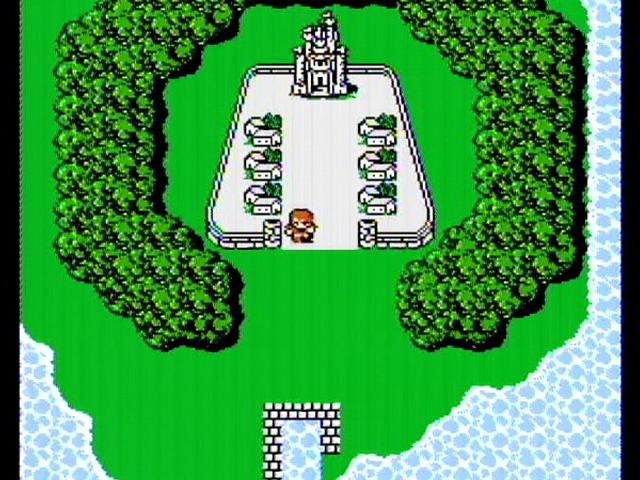
His daughter, Princess Sarah, has been kidnapped by Garland, a former knight of Cornelia who has taken her to the nearby Chaos Shrine.
The king promises to assist the Warriors of Light if they can rescue his daughter. Naturally, you head off to confront Garland. After navigating the shrine, you encounter the disgraced knight, defeat him, and rescue the princess.
It’s a fairly conventional opening, particularly by modern RPG standards.
However, once the Warriors return to Cornelia, the king orders a bridge built, allowing them to cross into the wider world.
And this leads to one of the most memorable moments in the original Final Fantasy.
As the party crosses the bridge, the game displays its title accompanied by Nobuo Uematsu’s now-iconic opening theme.
I think this is a rather clever piece of presentation.
Instead of beginning with an elaborate cinematic or a lengthy explanation of the world’s history, the game effectively uses your first small victory to mark the beginning of the real adventure. You’ve rescued a princess, defeated a villain, and earned the kingdom’s gratitude. And yet, everything you’ve accomplished so far is merely the introduction. The real journey is only just beginning.
From there, the game opens up considerably.
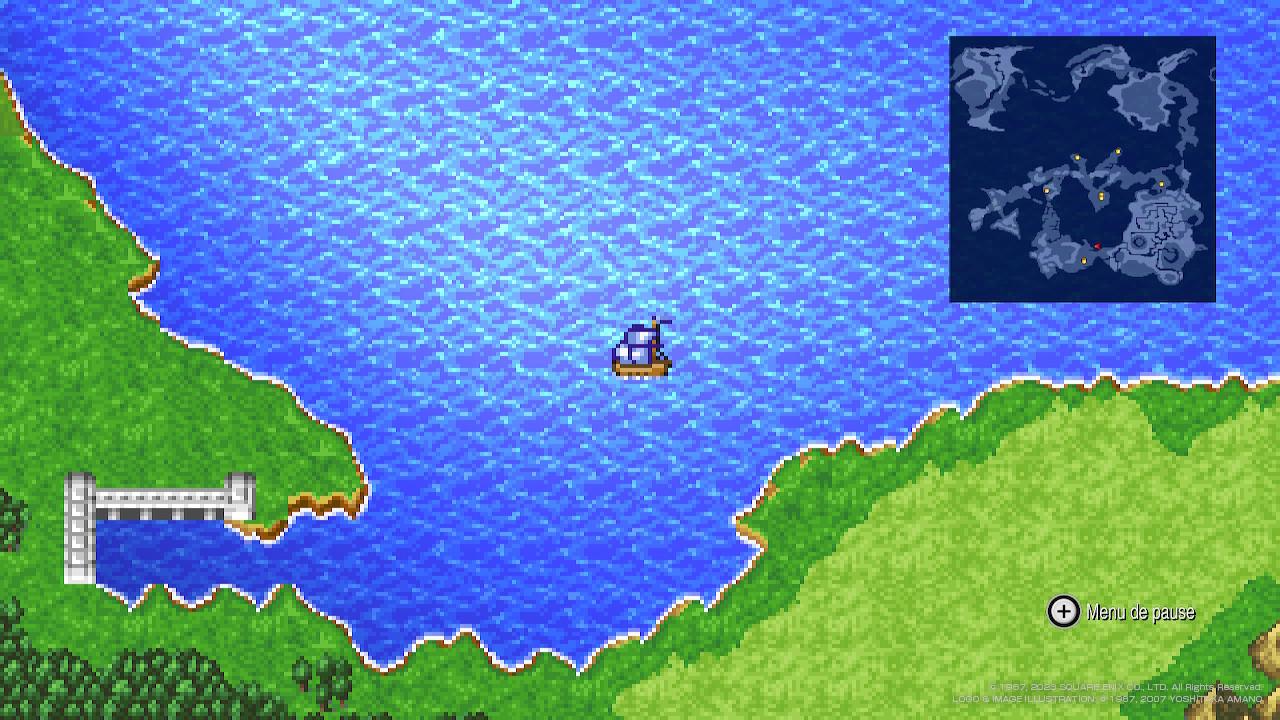
You eventually reach the port town of Pravoka, where a group of pirates led by Bikke has been causing trouble. After defeating them, the pirates surrender their ship, giving you access to new parts of the world.
I rather like how Final Fantasy uses these early encounters to gradually expand the player’s freedom. At first, you’re limited to exploring the area surrounding Cornelia. Then you cross the bridge, acquire a ship, and eventually gain access to other means of transportation. It’s a simple but effective way to make the world feel progressively larger.
A World Full of Small Adventures
One thing I appreciate about the original Final Fantasy is that its adventure isn’t simply a matter of travelling directly from one elemental crystal to the next.
Instead, much of the early game revolves around smaller quests that eventually contribute to your larger objective.
For example, there’s the situation involving the sleeping prince of Elfheim. The prince has been placed under a magical curse by Astos, a dark elf who has also stolen a crystal eye belonging to the witch Matoya.
Matoya, incidentally, is one of the more memorable supporting characters in the game. She’s unable to see without her crystal eye, and helping her recover it eventually allows the party to obtain a potion capable of awakening the sleeping prince.
The prince subsequently rewards the Warriors of Light with the Mystic Key, allowing them to unlock previously inaccessible doors throughout the world. This, in turn, leads to acquiring explosives that can be used to open a canal, making further exploration possible.
It’s essentially a series of interconnected errands, but I think there’s something rather charming about it. Rather than presenting the player with a long list of explicitly marked objectives, the game expects you to speak with NPCs, pay attention to what they’re saying, and gradually piece together where you’re supposed to go.
Of course, this can become frustrating. There are times when you’re given very little direction, and figuring out the next objective can involve travelling between towns and speaking with numerous characters.
I can appreciate the sense of discovery, but I also wouldn’t pretend that this approach is necessarily superior to the more structured storytelling of later games. Sometimes there’s a fine line between encouraging exploration and simply leaving the player wondering what the hell they’re supposed to do next.
Still, I think the game does a reasonably good job of creating the impression that you’re exploring a larger world filled with people who have their own problems. Even if most of those problems ultimately amount to finding an item and delivering it to someone else.
Character Classes: The Foundation of the Job System
One of the most important aspects of Final Fantasy’s gameplay is the ability to select the classes of your four characters before beginning the adventure.
There are six classes available:
- Warrior (originally Fighter): A heavily armoured physical attacker who can equip some of the game’s strongest weapons and armour.
- Monk (originally Black Belt): A martial artist who becomes increasingly powerful through unarmed combat.
- Thief: A relatively agile character who eventually develops into a much more capable fighter.
- White Mage: Specializes in healing, defensive magic, and spells effective against undead enemies.
- Black Mage: Focuses on offensive magic and dealing damage through elemental spells.
- Red Mage: A versatile class capable of using both white and black magic, alongside a reasonable selection of weapons and armour.
Once you’ve selected your party, those choices are essentially permanent, aside from the class upgrades you can unlock later. You can’t simply decide halfway through the game that your Black Mage would be better suited to becoming a Warrior.
This is something Final Fantasy III would eventually address through its more flexible job system.
I think the original game’s approach is interesting because it allows players to experiment with different party compositions from the very beginning.
You could create a relatively balanced party with a Warrior, Monk, White Mage, and Black Mage. Or perhaps you might prefer something more unconventional, such as four White Mages. I can’t imagine that being a particularly enjoyable experience, but the option is there.
The choices you make have a significant impact on the difficulty of the adventure. A party consisting primarily of physical attackers will have different strengths and weaknesses from one built around magic. And since you can’t freely change classes later, you’re forced to work with those decisions throughout the game.
I actually appreciate that to an extent. There’s something satisfying about committing to a particular party composition and figuring out how to overcome the challenges that arise.
However, I do think Final Fantasy III’s job system was ultimately a considerable improvement, particularly when it came to encouraging players to experiment without having to start a completely new game.
Bahamut and the Class Upgrades
One particularly memorable feature is the ability to upgrade your characters’ classes.
Eventually, after obtaining the airship, you can travel to a group of islands inhabited by dragons. Among them is Bahamut, the King of Dragons.
This is obviously a rather significant appearance when you consider how important Bahamut would eventually become to the franchise. However, unlike in later Final Fantasy games, Bahamut isn’t a summon you can call upon during battle.
Instead, he offers to grant the Warriors of Light more advanced classes if they can prove their courage.
To accomplish this, you must travel to the Citadel of Trials and retrieve a rather peculiar item known as the Rat’s Tail. Why a dragon king considers a rat’s tail sufficient proof of courage is anyone’s guess, but apparently that’s how things work in this world.
Upon presenting it to Bahamut, your characters receive their class upgrades. Warriors become Knights, Monks become Masters, Thieves become Ninjas, and the various mages become their respective Wizard counterparts.
The upgrades aren’t merely cosmetic. Knights gain access to basic white magic, Ninjas can use certain black magic spells, and the upgraded spellcasters gain access to more powerful magical abilities.
I like how this serves as a meaningful reward for exploration. It also provides a sense of progression beyond simply increasing your characters’ levels and acquiring better equipment.
And, of course, it’s another example of an element that would eventually become synonymous with the franchise.
Combat: Simple, Traditional, and Sometimes Frustrating
Final Fantasy features a fairly conventional turn-based battle system.
You encounter enemies while exploring the world or travelling through dungeons, select commands for your party members, and watch the action unfold. Defeating enemies rewards you with experience points and gil, allowing your characters to increase their levels and purchase better equipment.
It’s a straightforward formula, and I think it works reasonably well.
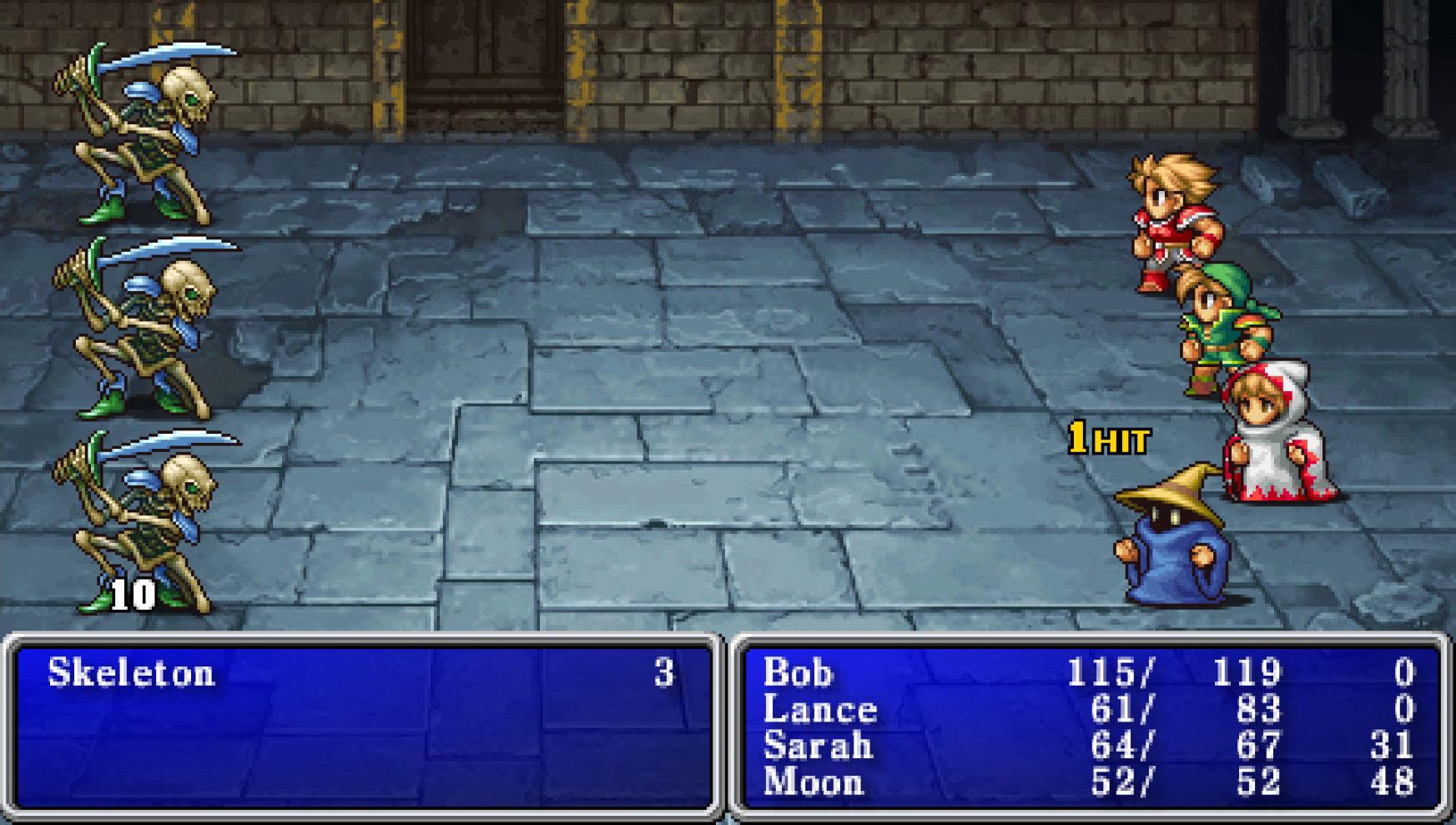
However, one thing worth remembering is that the version I played was considerably more forgiving than the original NES release.
For example, the original game used a magic system based on a limited number of spell charges for each spell level, rather than a conventional pool of MP. This meant that even if you had access to powerful magic, you could only cast spells of a given level a limited number of times before needing to replenish your charges. The Game Boy Advance and PSP-derived versions replaced this with a more familiar MP system, making magic considerably easier to manage.
There were also some rather unusual quirks in the original battle mechanics.
If several party members targeted the same enemy and the first character defeated it, the remaining attacks wouldn’t automatically redirect toward another opponent. Instead, those characters would simply waste their actions. It’s the sort of mechanic that might encourage players to think carefully about targeting, but I imagine it could become fairly irritating during encounters involving multiple enemies.
Later versions addressed this issue, and I think it’s an example of a quality-of-life improvement that doesn’t necessarily undermine the fundamental gameplay.
The original also contained a number of spells that didn’t function as intended because of programming bugs. Again, these are things worth considering when discussing the game historically, but they’re not necessarily problems I personally encountered in the mobile version.
What I remember most is that the combat was enjoyable enough, even if it lacked the complexity of later entries. There are no elaborate character-specific abilities, Limit Breaks, or complicated systems involving equipment and learned skills. Most encounters come down to choosing the appropriate attacks, managing your resources, and making sure your party is sufficiently prepared.
It’s basic, but I don’t necessarily consider that a bad thing. Sometimes there’s something enjoyable about an RPG that doesn’t require you to spend an hour figuring out how its progression systems work.
Exploration, Grinding, and the Peninsula of Power
Like many RPGs from the 1980s, Final Fantasy can be rather demanding when it comes to exploration and resource management.
Dungeons are filled with random encounters, and running out of healing items or magical resources can quickly become a problem. Depending on your party composition, you might find yourself returning to towns repeatedly to rest, purchase supplies, or improve your equipment.
There’s also a fair amount of grinding involved.
Personally, I don’t necessarily mind grinding in RPGs, provided the underlying combat remains enjoyable. However, I can understand why someone accustomed to more modern Final Fantasy games might find the experience rather repetitive.
One particularly amusing aspect of the original game is the infamous Peninsula of Power.
For anyone unfamiliar with it, there’s a small peninsula northeast of Pravoka where, in the original versions, the random encounter tables allow much stronger enemies to appear than you would normally expect to encounter so early in the adventure. These enemies belong to a more dangerous region of the world, but because of how the encounter areas were mapped, it was possible to fight them long before you were supposed to reach that part of the game. Naturally, this created an opportunity for players to gain experience and money considerably faster than they otherwise could.
Of course, there was also the very real possibility of getting your entire party slaughtered. But if you could survive the encounters, you could make the early portion of the game considerably easier.
I find this particularly amusing because it wasn’t an intended method of progression. Little quirks like these are part of what makes revisiting older RPGs so interesting.
While I don’t think every unintended exploit needs to be celebrated, I find it entertaining when players discover ways to manipulate a game’s systems, especially when those discoveries become such a well-known part of its history that people are still discussing them decades later.
Fantasy Meets Science Fiction
One aspect of the original Final Fantasy that I think deserves more attention is how it incorporates elements of science fiction into what initially appears to be a conventional fantasy setting.
At first glance, the world is largely what you’d expect from a traditional fantasy RPG. There are castles, kings, princesses, elves, dwarves, witches, dragons, and various monsters. Your characters wield swords, cast spells, and travel across the world on foot or aboard sailing ships.
However, as the adventure progresses, you gradually encounter evidence of a much more technologically advanced civilization.
The airship is perhaps the most obvious example. It provides access to previously unreachable locations, and it’s interesting that a vehicle so closely associated with the franchise was already present in the very first game.
Later in the adventure, you encounter the Lufenians, descendants of an ancient civilization that possessed incredibly advanced technology. Their ancestors created extraordinary structures, including the Flying Fortress, which has been taken over by Tiamat, the Fiend of Wind.
The fortress is particularly interesting because it introduces a noticeably different atmosphere from the castles and caves encountered earlier in the game. Instead of a conventional fantasy dungeon, you’re exploring the remains of a technologically advanced civilization.
There are also mechanical enemies, including the infamous Warmech, a powerful optional encounter that can prove considerably more dangerous than many of the game’s bosses.
I really like this combination of fantasy and science fiction, although the latter is less prominent here than in subsequent entries such as Final Fantasy VI, VII, and VIII. Even Final Fantasy IV, which initially appears to be a fairly traditional fantasy adventure, eventually introduces advanced technology and science-fiction elements.
I think it’s fascinating that this blending of genres was already part of the series’ identity in 1987. Right from the beginning, Square was willing to incorporate futuristic technology, ancient civilizations, and even time travel into its worlds.
Speaking of time travel, I’ll return to that particular subject in the spoiler section because it raises some rather interesting questions about the game’s ending.
Graphics and Presentation
Since my primary experience was with the mobile version, I can’t really offer a firsthand assessment of the original NES graphics beyond what I’ve seen in screenshots and videos.
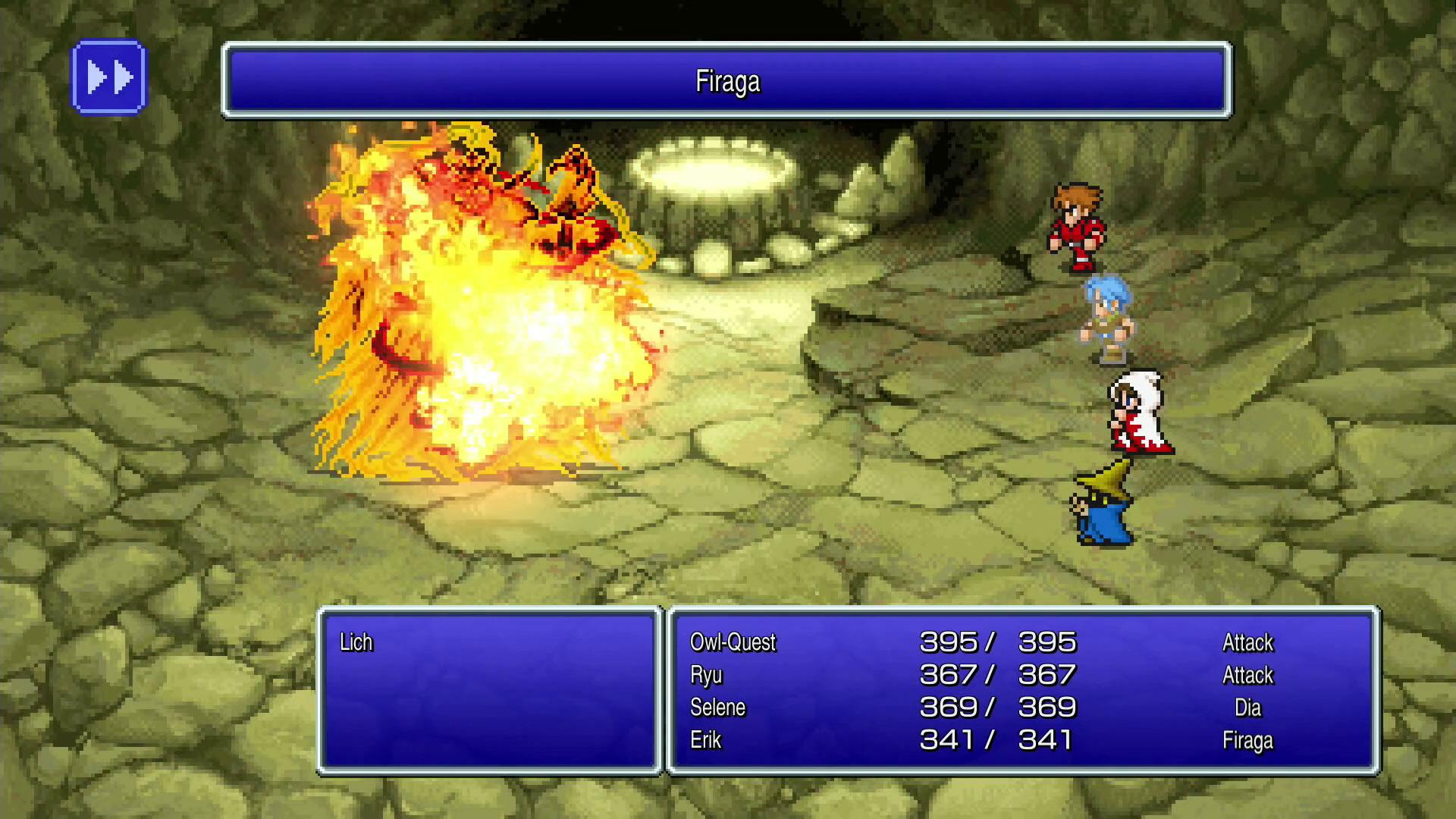
The version I played featured the enhanced sprite work introduced in the later remakes, with more detailed character sprites, environments, and battle backgrounds. The character sprites retained the recognizable designs of the original game while offering considerably more visual detail. And although the environments weren’t particularly elaborate, I appreciated the differences between the various towns, caves, castles, and other locations. There’s a certain charm to the pixel art in both this version and the Pixel Remaster. It’s not attempting to recreate the kind of visual spectacle associated with the more recent Final Fantasy games, and frankly, I don’t think it needs to.
I understand that some players might prefer the original NES presentation because it represents the game as it was originally designed, and I can respect that. But for someone who didn’t play the original, I think the later remakes offer a much more approachable experience.
Music: The Beginning of Nobuo Uematsu’s Legacy
If there’s one aspect of the original Final Fantasy that I think has aged particularly well, it’s the music.
Nobuo Uematsu would eventually become one of the most celebrated composers in video game history, and while I wouldn’t necessarily rank the original game’s soundtrack alongside his finest work, it contains several memorable compositions.
Perhaps the most important is “Prelude.” That familiar arpeggiated melody has become so closely associated with Final Fantasy that it’s difficult to imagine the franchise without it. It’s remarkable to think that something introduced in the very first game would continue appearing throughout the series decades later.
Then there’s the opening theme, which plays when the Warriors of Light cross the bridge near Cornelia. For me, this is one of the most recognizable compositions associated with Final Fantasy as a whole. It’s a relatively simple melody, but it does an excellent job of conveying the sense that you’re embarking on a grand adventure.
Another track I particularly enjoy is “Matoya’s Cave.” There’s something playful and whimsical about it, which I think suits the character and her rather unusual home.
I also like the music accompanying the Chaos Shrine. It has a mysterious, almost ominous quality that works well for a location associated with the game’s opening antagonist.
And, of course, there’s the battle theme.
Although the original game doesn’t feature the elaborate battle compositions that would eventually become common in later entries, I think its main battle theme remains recognizable and enjoyable. It’s energetic without being overly complicated, and it establishes a musical style that Uematsu would continue developing throughout the franchise. The overworld theme is another composition worth mentioning, particularly because it captures the feeling of exploration that defines much of the adventure.
As far as the individual towns are concerned, Final Fantasy doesn’t provide every location with its own distinctive musical theme. Most towns share the same general composition, although certain important locations, such as Cornelia Castle and Matoya’s Cave, have their own music.
I don’t consider that a particularly significant criticism. We’re talking about a game originally released in 1987, when developers were working with extremely limited memory and audio hardware. It seems rather unreasonable to expect every town to feature a completely unique composition, particularly when you consider everything else the developers were attempting to include.
Could the soundtrack have offered more variety? Certainly, but I think it’s important to distinguish between something being limited by its era and something being fundamentally poorly designed.
I wouldn’t rank the original Final Fantasy’s soundtrack alongside the likes of Final Fantasy IV, VI, VII, or IX, but I think it does an excellent job of establishing the musical identity of the franchise. Considering just how many of its melodies continue to appear in subsequent games, I would argue that its influence is undeniable.
The Different Versions and Missing Bonus Content
One thing I find unfortunate about the Pixel Remaster releases is that they omit additional content introduced in earlier remakes.
As I mentioned earlier, the version of Final Fantasy that I originally completed was based on the PSP remake, which itself incorporated additional content introduced in the Game Boy Advance release.
The most significant additions were the Soul of Chaos dungeons. These optional areas become accessible as you defeat the elemental Fiends, with each dungeon corresponding to a different element. They offer additional challenges, powerful equipment, and encounters with bosses originating from later Final Fantasy games.
For example, players can encounter familiar enemies such as Gilgamesh, Omega, Shinryu, and other powerful bosses. I rather like the idea of including these references. They’re not essential to the original story, but they provide something extra for longtime fans who recognize these characters and creatures from subsequent games.
The PSP edition also introduced the Labyrinth of Time, an additional challenge involving timed puzzles and encounters that culminates in a battle against Chronodia.
Both the Soul of Chaos dungeons and the Labyrinth of Time appeared in the original iPhone release, although, from what I understand, the corresponding Android port didn’t include them. Unfortunately, the Pixel Remaster omits this additional content entirely.
I understand that Square Enix wanted the Pixel Remasters to remain relatively faithful to the original releases, rather than attempting to combine every feature introduced across earlier releases. Still, I find the omission disappointing. There’s something unfortunate about a more recent version of a game lacking content that was present in editions released many years earlier.
Of course, the Pixel Remaster has its own advantages, including rearranged music, updated graphics, and various quality-of-life improvements. It also returns to a magic system more closely resembling the original game’s spell-charge mechanics.
Ultimately, I think the ideal version depends on what you’re looking for.
If you want something closer to the original experience, the Pixel Remaster is an excellent option. But if you’re interested in the additional dungeons and optional challenges, the GBA, PSP, and original iPhone editions offer content that isn’t available in the Pixel Remaster, with the PSP and iPhone editions also featuring the Labyrinth of Time.
Personally, I wish Square Enix had simply made the additional content optional rather than removing it entirely.
Nasir Gebelli and the People Behind Final Fantasy
One thing I find particularly fascinating about the early Final Fantasy games is the involvement of programmer Nasir Gebelli.
While Hironobu Sakaguchi is understandably recognized as the creator of Final Fantasy, and Nobuo Uematsu receives considerable attention for his compositions, I don’t think Gebelli gets nearly enough recognition among more casual fans.
Gebelli was an Iranian-American programmer who had already established a reputation for his technical abilities while developing games for the Apple II. He eventually joined Square in Japan, where he played a major role in programming the first three Final Fantasy games. What makes his involvement particularly interesting is that his background was in developing very different types of games.
In fact, he has mentioned that he hadn’t even encountered role-playing games before becoming involved with Final Fantasy. Yet he was responsible for implementing many of the technical systems that made these early games possible.
Considering the limitations of the Famicom hardware, I find that particularly impressive. Developers had to work with very limited memory, processing power, and cartridge storage. The games needed to accommodate large overworld maps, numerous towns and dungeons, battle systems, character statistics, dialogue, and a surprising amount of content. All of that had to fit within the constraints of an 8-bit console.
Gebelli’s technical expertise was particularly important, and his contributions continued through Final Fantasy II and III. He’s also associated with the remarkably fast airship movement in Final Fantasy III, an impressive technical achievement for the hardware.
It’s easy to overlook the programmers responsible for making these games function, particularly when discussing franchises where the writers, directors, artists, and composers receive most of the attention.
But I think it’s worth remembering that Final Fantasy’s success was built upon the contributions of numerous talented individuals. Gebelli’s role in the earliest entries is something I’ve always found rather cool.
Story Discussion : Spoilers Ahead
The Four Fiends and the Restoration of the Crystals
For much of the adventure, Final Fantasy presents a fairly straightforward conflict.
The Warriors of Light must travel across the world, defeat the Four Fiends, and restore the elemental crystals. Each Fiend is associated with a particular element.
Lich, the Fiend of Earth, is responsible for the decay affecting the land.
Marilith, also known as Kary in the original English localization, represents fire and resides within Mount Gulg.
Kraken, the Fiend of Water, is encountered within the Sunken Shrine.
And Tiamat, the Fiend of Wind, occupies the Flying Fortress. As the party defeats these creatures, the crystals gradually regain their light.
It’s a fairly conventional structure, and in some respects, it resembles the sort of adventure that would eventually become associated with the earliest Final Fantasy games.
However, the story takes a rather unexpected turn after the four crystals have been restored. Instead of simply ending with the defeat of the Fiends, the game reveals that their existence is connected to a much larger mystery that brings the story back to where everything began.
Garland, Chaos, and the Time Loop
One of the strangest aspects of Final Fantasy’s story is the revelation that Garland, the knight you defeated near the beginning of the game, is actually connected to the Four Fiends through a time loop.
After restoring the four crystals, the Warriors of Light return to the Chaos Shrine. There, they discover that the elemental forces threatening the world have been manipulated through a cycle involving the past and future.
The Four Fiends were originally sent forward in time from 2,000 years in the past. In the present, they restore Garland after his defeat at the hands of the Warriors of Light and send him 2,000 years into the past. Once there, Garland becomes Chaos and uses the power of the Fiends to perpetuate the cycle, sending them into the future. The result is an endless loop in which Garland effectively ensures his own continued existence. Naturally, the Warriors of Light must travel into the past and defeat Chaos to break the cycle.
I actually think this is a surprisingly ambitious concept for a game released in 1987. What initially appeared to be a straightforward fantasy adventure involving four heroes restoring magical crystals suddenly introduces science-fiction concepts involving time travel and causality. If you start thinking about the implications, things become rather complicated.
For example, if Garland is sent into the past after being defeated in the present, and the Four Fiends are subsequently sent into the future by Garland, which event actually started the cycle? The Fiends are responsible for Garland surviving his initial defeat, but Garland is also responsible for sending the Fiends into the future. It’s essentially a causal loop. Neither event has a clear beginning because each depends upon the other.
And while this is a perfectly legitimate science-fiction concept, I can’t help finding it amusing that the original Final Fantasy, of all games, decided to incorporate something like this into its ending.
You spend most of the adventure travelling around the world, collecting magical items, defeating monsters, and helping various kingdoms. Then, almost out of nowhere, you’re dealing with time travel and an immortal villain who has effectively trapped himself within a self-perpetuating cycle. It’s quite a shift.
So What Actually Happens to Garland?
This is where I find the ending particularly interesting.
Once the Warriors of Light defeat Chaos, the time loop is broken. The world is restored, and the events caused by the endless cycle are effectively erased or rewritten.
But what exactly does this mean for Garland? After all, Garland originally existed as a knight of Cornelia before the events of the game.
If the time loop is broken, does that mean he never becomes Chaos? And if he never becomes Chaos, does he still kidnap Princess Sarah? Would the Warriors of Light still be sent to rescue her? Or does breaking the cycle mean that those events never happen in the first place?
I suppose the intended explanation is that the Warriors of Light have altered history by defeating Chaos in the past, preventing the chain of events that originally led to the world’s decline. This would also mean that Garland’s transformation into Chaos never occurs in the restored timeline.
But this raises further questions about the Warriors of Light themselves.
If the world was never threatened by the Four Fiends, would the prophecy concerning the Warriors of Light still exist? Would the four heroes still have embarked on their adventure? And if not, how could they have travelled into the past to defeat Chaos in the first place?
I realize I’m probably overthinking the story of a relatively simple RPG from 1987, but that’s part of what makes it interesting to me. The game introduces a concept with some rather significant implications without attempting to explain every possible consequence.
Depending on how literally you interpret the ending, you could argue that the Warriors of Light have effectively erased the events that made them heroes. Their victory restores the world, but it also creates a timeline in which their adventure may never have occurred. It’s a somewhat bittersweet conclusion when you think about it. They’ve saved everyone, but the people they saved may never know what they accomplished.
And perhaps that’s the point. The Warriors of Light aren’t seeking recognition or glory. They exist to restore the world’s balance, even if doing so means that their deeds are forgotten.
For a game with such a basic narrative, I think that’s a surprisingly interesting idea.
A Surprisingly Ambitious Ending
I also appreciate how Final Fantasy brings the adventure full circle.
The Chaos Shrine is the location of the game’s first major confrontation, where the Warriors of Light rescue Princess Sarah and defeat Garland. It’s also the location of the final dungeon, where the heroes travel into the past and confront Chaos.
There’s something satisfying about returning to the same place where the adventure began, only to discover that its significance was far greater than you initially realized. It’s a relatively simple storytelling technique, but I think it works.
Later Final Fantasy games would develop considerably more elaborate narratives involving time travel, alternate worlds, and the consequences of manipulating history. However, I think it’s worth remembering that the original game was already experimenting with these concepts. And although the execution is understandably limited, I appreciate the ambition.
Conclusion: Respecting the Foundation Without Ignoring Its Age
I find the original Final Fantasy somewhat difficult to judge. On a sentimental level, I like it. It’s the game that established a franchise I’ve enjoyed for much of my life, and there’s something genuinely appealing about returning to the beginning and seeing where so many familiar elements originated.
The Warriors of Light, elemental crystals, character classes, airships, recurring monsters, Bahamut, and Nobuo Uematsu’s recognizable musical themes all have their roots here. It also established the idea that Final Fantasy could blend traditional fantasy with science-fiction elements, something that would become increasingly important throughout the franchise. And I think its story, particularly the revelation involving Garland and the time loop, is more ambitious than it initially appears.
However, I also don’t want to pretend that the game is somehow beyond criticism simply because of its historical significance.
The characters are largely anonymous, the story is relatively basic, the battle system lacks the complexity of subsequent games, and certain aspects of the dungeon design and exploration can feel rather tedious. It can also require a considerable amount of grinding, particularly if you’re playing one of the older, less forgiving versions. And while the soundtrack contains several memorable compositions, I wouldn’t rank it alongside the finest work Nobuo Uematsu would eventually produce.
But that’s precisely why I think context matters.
It seems rather unreasonable to evaluate a game released in 1987 using the same expectations one might have for Final Fantasy VII Remake, Rebirth, or Final Fantasy XVI. The technology, development resources, and conventions of the medium were completely different. That doesn’t mean we should excuse every shortcoming, but I think it’s important to appreciate what the developers were attempting to accomplish with the tools available to them.
It’s also worth remembering that the original Final Fantasy was developed during a period when the Japanese RPG genre was still establishing itself. Games such as Dragon Quest had already demonstrated the potential of RPGs on home consoles, but the conventions that would eventually define the genre were still being developed.
In that context, Final Fantasy was a substantial achievement. It offered a large world to explore, multiple character classes, an enjoyable adventure, and enough flexibility to encourage different approaches to party composition. And perhaps most importantly, it established a foundation that Square would continue building upon for decades.
Final Fantasy II would experiment with a more character-driven narrative and an unconventional progression system. Final Fantasy III would expand the original game’s class system into something considerably more flexible. And by the time the franchise reached Final Fantasy IV, Square had begun combining those earlier ideas into the more cinematic, character-driven experiences that would eventually define much of the series.
Looking back, I think it’s fascinating to see that progression. Each of the earliest games contributed something important, even when subsequent entries abandoned or significantly revised the ideas introduced by their predecessors.
As for the original Final Fantasy, I wouldn’t necessarily recommend it as someone’s introduction to the franchise today, particularly when there are considerably more accessible entries available. But I do think it’s worth experiencing, especially for anyone interested in the history and evolution of Japanese RPGs.
Is it one of my favourite Final Fantasy games?
Not really.
Do I think it’s one of the most important?
Absolutely.
It’s a relic of its time, but I don’t mean that as an insult. It’s a reminder of just how far the franchise has come, and how much of what we now associate with Final Fantasy was already present in its earliest incarnation. And while I might prefer the stories, characters, music, and gameplay of many subsequent entries, there’s something rather special about returning to the game that started everything.
After all, without Final Fantasy, there wouldn’t have been a Final Fantasy II, III, IV, or any of the other games that followed. Considering how much enjoyment I’ve gotten out of the franchise over the years, I think that alone makes the original worth appreciating.
Final Rating: 3.75/5
Good - Historically Significant
| Category | Rating |
|---|---|
| Story | 3.5/5 |
| Characters | 2.5/5 |
| Combat and Gameplay | 3.5/5 |
| Character Class System | 4/5 |
| World and Exploration | 3.75/5 |
| Graphics (Mobile Remake) | 4/5 |
| Music | 4.25/5 |
| Historical Significance | 5/5 |
| Overall Rating | 3.75/5 |
-
The Pixel Remaster, which was originally released for Android and iPhone was a re-release of the original NES and SNES games with upgrade 2D pixel graphics. This release was nearly a 1:1 remaster of the original games as they did not include any of the additional dungeons or weapons that the GBA, PSP, and 2D DS remakes included. The only new content I am aware of is that part of FF VI’s Opera House scenes are rendered in a mixture of 2D (for the sprites) with a 3D environment. ↩︎