
Valkyria Chronicles 3 - A Remastered Review
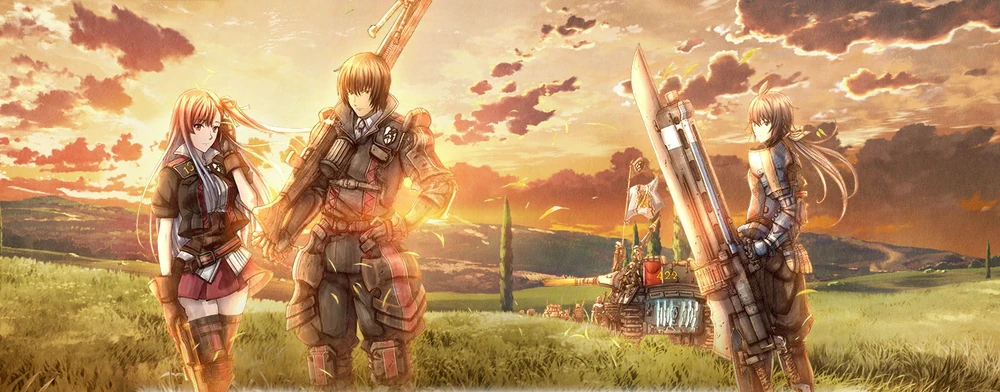
When I originally wrote about Valkyria Chronicles 3 back in 2023, my review was considerably shorter than the ones I later wrote for the first two games. Those ended up being much more substantial retrospectives, while my original look at the third game barely scratched the surface of why I enjoyed it as much as I did.
There was also another problem at the time: I hadn’t actually been able to experience everything in the game.
Valkyria Chronicles 3 never received an official western release. I own a physical copy of Valkyria Chronicles 3: Extra Edition, but playing it in English meant relying on the fan translation released in 2014.
That project deserves a tremendous amount of credit. Without it, most English-speaking players probably wouldn’t have been able to experience the game at all.
But it wasn’t complete.
The main story was translated, along with enough of the game to make it perfectly playable, but a fair amount of optional material remained in Japanese. That included some of the DLC and other content I simply skipped because there wasn’t much point playing through story-heavy material I couldn’t understand.
That situation finally changed earlier this year with the release of a completely new English retranslation of *Valkyria Chronicles 3: Extra Edition* which was released in February. Rather than simply cleaning up the old patch, it retranslates the script from scratch, fixes numerous errors and, most importantly for me, translates the DLC and other material that wasn’t available in English through the old patch.
At some point I’ll have to load back up my save and play the extra material and give the one Valkyria DLC another try.
I previously called it the best game in the franchise. After playing Valkyria Chronicles 4, I don’t know if I’m quite as certain about that title anymore, but I still think the third game may represent the point where Sega found the best balance between what worked in the original Valkyria Chronicles and the new ideas introduced in Valkyria Chronicles 2.
It takes a lot from the second game, it just does almost everything better.
Back to the Second Europan War
One of my biggest problems with Valkyria Chronicles 2 wasn’t necessarily its gameplay.
Mechanically, I actually think the second game introduced several good ideas.
The issue was everything surrounding those ideas.
The original Valkyria Chronicles was fundamentally a story about war. It wasn’t relentlessly miserable, nor did it need to be. Welkin’s strange obsession with nature, the interactions between the members of Squad 7 and some of the sillier character moments gave the game personality.
But those moments existed alongside a conflict that had real consequences.
People died.
Towns were destroyed.
Families were separated.
The persecution of Darcsens wasn’t simply background decoration.
Even though Gallia was clearly the country defending itself against an Imperial invasion, the story wasn’t afraid to show that prejudice and ugliness existed within Gallian society as well.
Then Valkyria Chronicles 2 jumped forward and moved everything into a military academy.
I still think the Gallian Civil War was a genuinely interesting idea. In fact, looking back at it, there is probably an even better game buried somewhere inside that premise.
The problem was the tone.
You have an attempted revolution being driven partly by racial hatred and political instability following a major war, but you’re experiencing much of it through school festivals, class rivalries and characters who initially feel like exaggerated anime stereotypes.
It never quite fit together for me.
Valkyria Chronicles 3 feels like Sega realized the errors they made with Valkyria Chronicles 2.
Instead of continuing forward in the timeline, it goes back to 1935 EC and takes place alongside the original game.
We’re fighting the same Second Europan War.
We’re just seeing a very different side of it.
The Story
Instead of Squad 7, Valkyria Chronicles 3 follows Gallian Army Squad 422, better known as the Nameless.
Calling them a squad almost makes their situation sound more respectable than it actually is.
The Nameless are essentially a penal military unit made up of criminals, deserters, political inconveniences and people who have simply managed to upset the wrong person.
Their names are stripped from the official record, instead, they’re assigned numbers.
Kurt Irving becomes Number 7.
Imca is Number 1.
Riela Marcellis is Number 13.
And if they die?
Officially, they barely existed in the first place.
This immediately gives the game a darker atmosphere than Valkyria Chronicles 2 and, in some ways, even the first game.
Squad 7 were militia soldiers defending their home.
Class G were students who gradually found themselves fighting in a civil war.
The Nameless are expendable.
They’re sent into battles that Gallia doesn’t want associated with its regular military, or even their militia. They’re expected to accomplish objectives that would otherwise be considered suicidal, and if something goes wrong, the government can simply deny responsibility.
It’s a great premise.
It also gives Sega a convenient way to tell another story during the events of the original game without constantly asking why nobody ever mentioned these people.
Nobody mentions them because they’re not supposed to.
Kurt, Imca and Riela
Welkin barely feels like a military commander when we first meet him. He’s more interested in insects, plants and whatever strange animal happens to be nearby.
Avan is energetic and enthusiastic to an almost ridiculous degree.
Kurt actually wants to be a soldier.
Before being falsely accused of treason and dumped into Squad 422, he had ambitions within the Gallian military. He believes in discipline, strategy and the responsibilities of command.
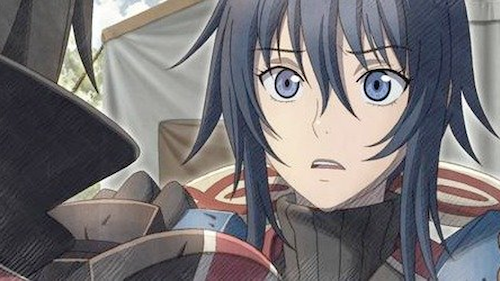
Kurt doesn’t suddenly decide that Gallia is evil. He continues believing in what the country is supposed to represent while gradually realizing how badly the people running its military can fail those ideals.
Riela begins from almost the opposite position.
She’s considered cursed because she repeatedly survives battles in which everyone around her dies. Instead of anyone thinking that maybe there’s another explanation, people decide that she must be some kind of jinx.
That reputation eventually follows her into the Nameless.
And then there’s Imca.
She’s much more closed off than either of them and has her own reasons for fighting, particularly her desire for revenge against the Valkyria responsible for destroying her home.
The relationship between the three is one of the strongest parts of the game.
And yes, there’s eventually a romantic element involving Kurt, Riela and Imca. Although during the course of my playthrough, I preferred Imca over who the game often feels like is their preferred heroine in Riela.
Extra Edition gives Imca additional material, and that’s another reason I’m interested in returning with the new translation. I wasn’t able to experience everything surrounding these characters properly the first time around.
The Nameless Feel Like an Actual Unit
The rest of Squad 422 are also considerably more memorable to me than most of Class G. That isn’t necessarily because every character receives some enormous story arc. It’s because the game does a better job making them feel like people who actually belong to the same unit.
One thing Valkyria Chronicles 2 did well was giving individual characters missions that fleshed out their personalities. The problem was that you often had to go looking for that development. Valkyria Chronicles 3 retains character-specific episodes but integrates the squad into the larger story more effectively.
At the beginning, many of them don’t even trust Kurt. Why should they? From their perspective, he’s another military officer who has suddenly arrived and expects a bunch of people who have been discarded by the Gallian Army to follow his orders.
Watching Kurt gradually earn that trust is much more satisfying than having everyone immediately accept him because he’s the protagonist. There’s also Gusurg, who is the first to befriend Kurt and help him with the squad, he becomes particularly important later.
I’ll get to him in the spoiler section.
Taking Valkyria Chronicles 2 and Fixing It
From a gameplay perspective, the easiest way I can describe Valkyria Chronicles 3 is that it feels like Sega took Valkyria Chronicles 2, looked at what worked, looked at what drove people bananas, and threw the bad ideas away.
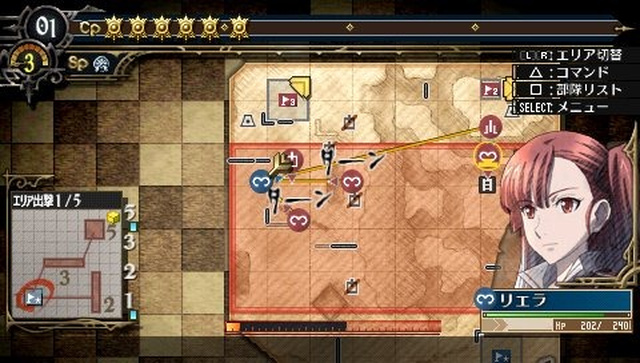
The basic BLiTZ system remains intact. You still move around an overhead command map before directly controlling individual characters from a third-person perspective.
You still spend Command Points to activate units. You still have Action Points determining how far they can move. As this is another PSP game, you still have the multi-area battlefield system introduced in Valkyria Chronicles 2, but it doesn’t feel as though it is painfully obvious that they re-used maps as much as Valkyria Chronicles 2 did.
It isn’t quite as visually impressive as the first game’s large battlefields, but I still think it was a clever solution to the limitations of the PSP.
As in Valkyria Chronicles 2, capturing bases effectively becomes part of navigating the battlefield. Take a camp and suddenly you can deploy troops into another area. Lose one and the enemy can do the same thing to you. It adds another layer to positioning that wasn’t really present in the original.
The problem with Valkyria Chronicles 2 was that all of this sat underneath one of the most irritating progression systems in the series. Thankfully, for the most part Valkyria Chronicles 3 is considerably better1.
Classes and Levelling
This is an area where Valkyria Chronicles 3 feels like an interesting mixture of the first two games rather than simply following either one.
The original Valkyria Chronicles kept things wonderfully simple.
You levelled classes.
If Scouts went from Level 5 to Level 6, every Scout benefited.
That meant you weren’t punished for rotating characters in and out of your squad. Valkyria Chronicles 2 expanded the number of classes considerably, which I liked, but tied individual advancement to credits and certificates and that became an absolute grind.
You could know exactly what class you wanted a character to become and still end up repeatedly playing missions because the game refused to give you the particular certificate you needed. Valkyria Chronicles 3throws most of that away.
Instead, experience can be invested into broader statistics that benefit the squad, while individual soldiers improve their proficiency in different classes by actually using them. More importantly, characters aren’t trapped inside rigid class paths. Pretty much anyone can become whatever you want.
Want Kurt to be a Scout? Go ahead. Want him as a Sniper? You can do that too. Shocktrooper? Lancer? Engineer? Nothing is really stopping you.
Characters still have preferred classes and statistical differences, so the choice isn’t completely meaningless, but you’re given considerably more freedom to experiment.
That’s probably my favourite aspect of the progression system.
It feels like a compromise between the simplicity of the original and the customization introduced in Valkyria Chronicles 2 (VC2).
There Is Still Grinding
I don’t want to make it sound like Valkyria Chronicles 3 (VC3) completely eliminates grinding, because it doesn’t. If you’re just interested in finishing the main story, it’s dramatically less irritating than VC2.
If you want to unlock everything? You’re going to replay missions.
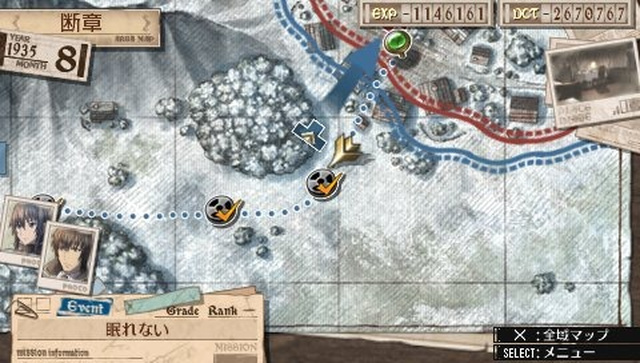
Character Fragments, which contain many of the individual character stories, require repeatedly deploying particular characters. Some unlock after a character has been deployed dozens of times. Improving individual class proficiency and unlocking the better Potentials also requires actually using characters in different classes and completing actions with them.
So yes, there’s still a grind. It’s just nowhere remotely as bad, that’s an important distinction.
VC2 regularly made me feel like I was replaying missions because a random number generator refused to give me permission to progress the way I wanted. VC3 usually makes me feel like I’m working toward something.
If I’m using someone repeatedly as a Scout, they’re becoming a better Scout. If I want to develop another class, I put them into that class and use them. If I’m trying to unlock a character’s profile or additional story, I know what I’m working toward.
It’s still repetitive if you’re trying to complete absolutely everything, but it feels substantially less hostile toward the player, and after VC2, I’ll happily take that.
Direct Command Is One of the Best Additions in the Series
The three main characters also receive unique Special Powers. Kurt’s Direct Command is probably one of my favourite gameplay additions in the entire franchise. Direct Command allows Kurt to take up to two nearby squad members with him while moving around the battlefield.
That might not sound revolutionary until you actually start using it. Classes in Valkyria Chronicles have wildly different movement ranges.
Scouts can run halfway across the planet. Lancers sometimes feel like they need a lunch break after crossing the street.
Direct Command lets Kurt bring slower units along with him without consuming their Action Points in the process.
Suddenly you can move a Lancer or Sniper far deeper into the battlefield without spending several Command Points individually marching them forward.
You can reposition multiple soldiers. You can set up cooperative attacks. You can move important units through dangerous areas more efficiently.
It feels like something a commander should actually be able to do.
I likely am not alone in liking the idea either, because Direct Command returned in Valkyria Chronicles 4, where infantry leaders can again bring other soldiers with them around the battlefield.
That’s one of those mechanics that feels so natural after using it that I almost miss it when going back to the original game.
We Finally Get to Be a Valkyria
Then there’s Riela.
This is something I’d completely forgotten to give enough attention to in my original review. For the first time in the series, we finally get to actually control a Valkyria (with her powers) during normal gameplay.
Not fight one.
Not watch one annihilate half the battlefield in a cutscene.
Not have Alicia suddenly activate her powers while the game takes control away from you.
We actually get to do it ourselves.
Once Riela’s Valkyria ability becomes available, you can spend a Special Point and transform her.
And it is awesome.
She becomes effectively invulnerable while moving through enemy fire and gains access to a hugely powerful Valkyrian lance attack.
After spending two games watching characters like Selvaria, Alicia, and Aliasse demonstrate how ridiculously powerful a Valkyria can be, finally being handed that power feels like a payoff. There’s also something hilariously satisfying about looking at a fortified enemy position that would normally require careful planning and thinking: Well… Riela.
Obviously the game has to place some restrictions around it or she would completely destroy the balance. Special Points are limited, and her ability isn’t simply an automatic victory button against everything, but that almost makes it better.
You have to decide when becoming a Valkyria is actually worth it.
Do you use it to break through a heavily defended base?
Save it for a boss?
Use her ability to survive a route that would normally shred an ordinary unit with interception fire?
It becomes a tactical resource rather than something you can spam every turn. From the perspective of someone who had played the first two games before VC3, simply being able to directly control a Valkyria was incredibly cool.
Imca’s Open Fire
Imca rounds out the trio with her own special gameplay mechanic: Open Fire.
When her ability is used, Imca can use her special weapon, which is essentially a modified lancer weapon, to target multiple enemies at once, allowing you to absolutely wreck a group if you position her properly.
You need to get the targets into her firing arc, which means you can’t simply activate the ability from anywhere on the map and delete everything, but when it works, it works.
Between Imca’s Open Fire, Riela’s Valkyria transformation and Kurt’s Direct Command, the three main characters genuinely feel different from everybody else.
More importantly, their abilities serve different purposes.
Riela is raw power, Imca is crowd control, and Kurt is mobility and positioning.
Of the three, Direct Command is probably the least flashy, but at times the most useful and the one I appreciate the most.
Still Very Obviously a PSP Game
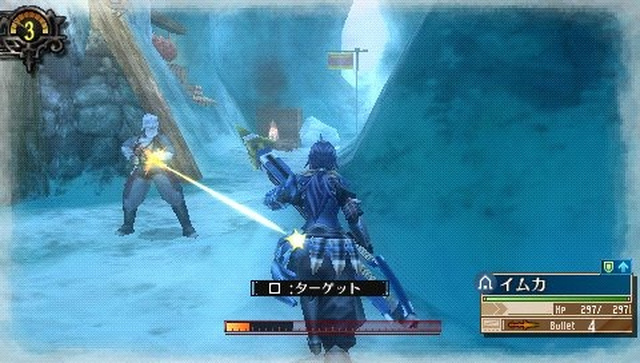
There is no getting around the fact that Valkyria Chronicles 3 was designed for the PSP.
If you play it immediately after the original game or Valkyria Chronicles 4, the downgrade in presentation is obvious: The battlefields are smaller, the environments are simpler, and there is a lot more visual novel-style storytelling.
There are also instances where you can notice reused content from Valkyria Chronicles 2, in terms of the maps, assets, and some animations. You can absolutely tell the games were built on the same foundation, which is no surprise, however, it doesn’t bother me nearly as much in VC3.
Part of that is because the missions themselves are better. Part of it is because I’m not spending nearly as much time replaying the same maps trying to obtain some stupid certificate. A huge part of it is simply that I’m more invested in what’s happening.
Reused content becomes a lot more noticeable when you’re already bored. When I’m actually looking forward to the next story sequence, I’m considerably more forgiving.
I’d still love to see what Valkyria Chronicles 3 would look like rebuilt on modern hardware. Of all the games in the series, this might be the one that would benefit most from a full remake. Give me these characters and this story with the scale and presentation of Valkyria Chronicles 4 and I’d be there immediately.
The Music
Hitoshi Sakimoto returned to compose the score, and it has that immediately recognizable Valkyria Chronicles sound. There are the large military pieces you would expect during battles, quieter tracks for the character scenes and some genuinely fantastic arrangements of themes heard elsewhere in the series.
What really sticks out to me are some of the more guitar-heavy pieces. There’s almost a country or western feeling to parts of the soundtrack. I don’t mean that we’re suddenly listening to somebody singing about their pickup truck while Kurt attacks an Imperial base. It’s more the instrumentation.
There’s something about the acoustic guitar arrangements that gives certain scenes this strangely relaxed, almost wandering quality that shouldn’t necessarily fit a game about a penal military unit fighting a brutal war, but it works here.
The soundtrack includes guitar arrangements of the Valkyria theme, Desperate Fight, Championship and even the series’ main theme. That variety is important because the game itself moves between some pretty dark material and quieter scenes involving the Nameless simply existing together as a group.
Music does a lot of the work in selling those transitions.
In my last review, which was about Valkyria Chronicles 2, I didn’t really comment on the music at all, to be fair although the music score was good and another example of the stellar work from Hitoshi Sakimoto, none of the tracks resonated with me. I can’t recall any tracks from that game, whereas this one had more memorable tracks, especially Open Fire!, the track associated with Imca and her special ability in this game, and the main theme.
It’s one of those soundtracks where hearing certain tracks immediately takes me back to the game.
A Much Better Balance of Tone
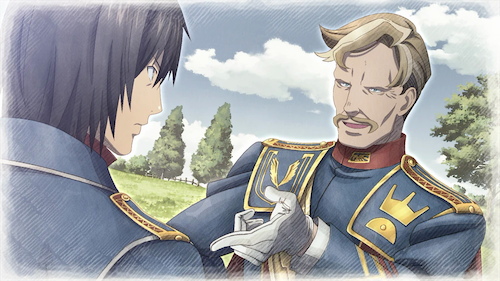
The darker story doesn’t mean VC3 is constantly depressing, that’s another thing I think it gets right.
There are jokes, there are strange characters, there are romantic moments between Kurt and the two heroines. There are scenes where the Nameless simply hang around and act like normal people, but the game doesn’t forget why they’re together.
They’re still soldiers that are still fighting a war. Unlike Squad 7, they’re doing it while their own military treats them as disposable. That’s where I think VC3 comes much closer to the original than VC2 did.
The first game understood that lighter character moments make the darker events hit harder. If everybody is miserable from the opening scene until the credits roll, eventually misery just becomes background noise. You need to understand what these characters have to lose. VC3 does that.
How Well Has It Held Up?
Surprisingly well, despite that it is a PSP game, we can’t pretend otherwise. Mechanically, there’s very little here that makes me feel like I’m putting up with an old game because of nostalgia.
The BLiTZ system is still excellent. The class system gives you a lot of flexibility. The new abilities of the main trio adds another strategic element to the game. Direct Command remains a fantastic mechanic.
The smaller maps make sense within the limitations of the hardware, and most importantly, the game improves upon VC2 without simply throwing everything VC2 attempted into the garbage. That’s probably my favourite thing about Valkyria Chronicles 3, the development team learned from the makes of VC2.
VC2 introduced some good ideas buried underneath frustrating systems, VC3 kept the good ideas, and it removed much of the frustration.
VC3 also wrapped everything inside a story that feels much closer to what attracted me to the original game in the first place.
Why I’m Going Back
The new translation gives me an excuse I didn’t really need.
The February 2026 project is a completely separate retranslation from the old 2014 patch, translating the script again from the source rather than simply editing what was already there. It also covers DLC and material the previous English release didn’t fully translate.
That’s important to me because there were areas of Extra Edition I simply didn’t complete during my original playthrough, because of the parts which the original team did not translate.
As it’s been only about 2-3 years since I played through the game, I’m curious if my opinion will change when I go through it again.
Maybe I’ll notice more of the flaws. Maybe I’ll appreciate certain characters more. Maybe some of the things I remember being frustrating won’t bother me anymore, or maybe I’ll finish it and decide that yes, that I still really like it and feel frustrated as to which one is my favourite between Valkyria Chronicles 1, Valkyria Chronicles 3, or Valkyria Chronicles 4.
Either way, I’m looking forward to finding out.
Story – Spoilers
Everything below this point contains major spoilers for Valkyria Chronicles 3.
The story is strong part as to why Valkyria Chronicles 3 stuck with me as much as it has. There are parts I’ve forgotten since I finished it, which is another reason I want to replay it, but I remember becoming considerably more invested as everything started coming together.
One of the most interesting parts is how the story slowly complicates the idea that Gallia is automatically the “good” side simply because we’re fighting for it. It is not like Gallia is secretly evil, the Empire is still invading, nut Squad 422 reveals the uglier side of the Gallian military in a way that Squad 7 generally doesn’t.
The Nameless are proof of that by themselves, then we get Gusurg.
Gusurg’s Defection
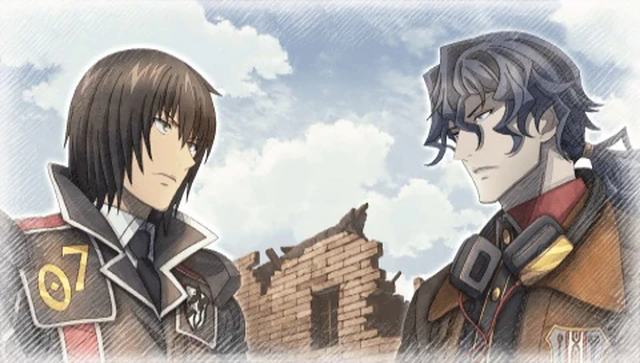
He becomes something resembling Kurt’s right-hand man and that’s what makes what happens later work.
Gusurg isn’t some obvious traitor waiting for the opportunity to reveal himself. You understand why he’s reaching his limit, given everything that is happening around him, how his squad is treated, and most importantly his fellow Darcens, he is afterall a Darcsen serving a country where Darcsens continue to face discrimination.
He watches the Gallian military treat Darcsen lives as less important. He’s expected to keep following orders from the same institution that threw him into a penal unit partly because his advocacy for Darcsen rights made him inconvenient.
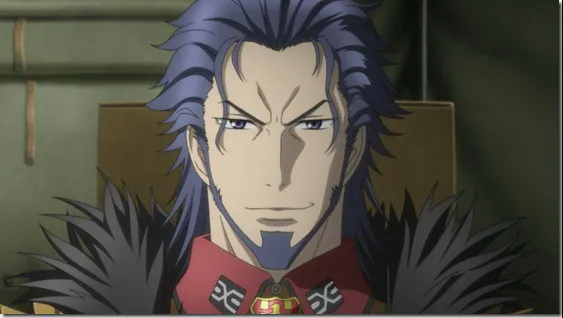
Eventually, he encounters Dahau, the leader of Calamity Raven, the primary antagonist in this game. Dahau offers something Gallia doesn’t, a future vision of Darcsen independence. You don’t necessarily have to agree with what Gusurg ultimately does to understand how he gets there.
His defection feels tragic rather than arbitrary. It feels like someone finally reaching the point where he can’t reconcile his loyalty to his friends with his anger toward the country they’re fighting for. Once he joins Calamity Raven, he becomes a particularly effective opponent for Kurt because he understands how Kurt thinks, which makes him such a great rival for Kurt.
Gusurg doesn’t suddenly become Kurt’s equal because the plot needs another boss. He spent half the game beside him and watched Kurt plan operations. He knows how Kurt responds to problems, he knows the kind of risks Kurt is willing to take, and he understands him well enough to anticipate him.
There’s a point after one of their battles where Gusurg essentially acknowledges that you can’t beat Kurt unless you go all-out because he knows exactly how dangerous Kurt is. That relationship gives their fights a personal element that wouldn’t exist if Gusurg were simply another Calamity Raven officer. He’s fighting his former friends.
Kurt is fighting someone who helped him become accepted by the Nameless in the first place, and underneath everything, you get the sense that the respect between them never completely disappears. That’s what got to me. Neither of them really wanted things to end the way they did.
Calamity Raven

Dahau isn’t fighting because he’s suddenly become an Imperial patriot, he wants an independent homeland for the Darcsen people, which the Imperial crown-prince Maximilian has promised him as a reward.
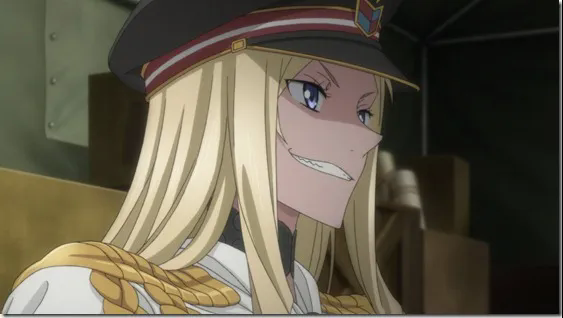
What really piqued my interest is when you discover that Cardinal Gennaro Borgia has been involved with Calamity Raven.
Cardinal Borgia
I remember the revelation involving Borgia really grabbing my attention as it felt unexpected, Borgia is supposed to be in a leadership position in a religion which places the Valkyria as saviours of the World. I would imagine given the backstory that unjustly places the blame for the historical devastation of Europa on the Darscens, that Borgia would be the least likely to form any kind of positive alliance with any Darcsens.
Until that point, Calamity Raven’s larger plans already felt like there was something else going on behind them. Finding out that a powerful Yggdist cardinal had secretly been supporting them made everything feel much larger. Borgia wasn’t helping them because he’d suddenly become a great supporter of Darcsen rights, he had his own ambitions and Calamity Raven were useful to him.
Borgia had promised support for Dahau’s dream of an independent Darcsen homeland, while pursuing his own goal of expanding Yggdist influence over Europa.
As the war begins to effectively end with the death of Maximillian, the game reveals that Borgia had discovered the ruins of a Valkyrian weapon in Imperial territoy. These ruins were called the Hammer of the Valkyrur, which appeared to be centralized around a Valkyrian lance, similar to the weapon that Selvaria and Alicia use.
Borgia oversaw the modernization of the facility, especially its main weapon, using the latest in technology to create an enormous ballistic weapon. Eventually they were able to realize the weapon’s potential, incorporating rocketry and sophisticated trajectory equipment into the Hammer.
With the death of Maximilian, Dahau, the leader of Calamity Raven, loses the support that made his dream remotely achievable which leaves Calamity Raven with nowhere left to go. So Dahau kills Borgia, takes the key to the Hammer and decides to use the weapon as one final attempt to force the creation of a Darcsen nation.
By this point, everyone is running out of options.
The Empire has lost, Calamity Raven’s political backing is gone, Squad 422 is also left on their own with no backing of the Gallian military to try to stop Calamity Raven.
Dahau’s dream hasn’t disappeared, but the path he thought would achieve it has, so he reaches for the most destructive option available. That leads directly into the final confrontation with the Nameless on Imperial territory.
Becoming Nameless Again
I also love the way Kurt handles the final mission, by this point, Squad 422 has finally been vindicated, and the charges that led to Kurt’s demotion to the Nameless was revealed - the military general Carl Eisler had been secretly conspiring with Borgia to betray Gallia, he falsified charges of treason on Kurt, as he feared that Kurt had discovered the conspiracy when he returned a letter to Eisler.
Kurt’s name has finally been cleared. The Nameless have effectively earned the right to stop being Nameless, but then Dahau threatens everything with the Hammer.
The problem is that the war is still not over. Gallia can’t simply send troops deep into Imperial territory immediately after reaching a cease-fire without potentially starting everything again.
So Kurt does something that perfectly summarizes how much he has changed, he chooses to become Nameless again, not as a punishment, but his decision to stop Dahau. He asks for himself and the squad to effectively be removed from the equation so they can cross the border and stop Dahau without Gallia officially taking responsibility.
At the beginning of the game, having his identity stripped from him is one of the worst things that happens to Kurt, but by the end, he willingly gives it up to protect everyone else.
That’s a pretty satisfying character arc and it changes what “Nameless” means. At first, the name exists because the Gallian military considers these people disposable. By the end, it’s something the squad chooses for themselves.
They’re no longer Nameless because somebody decided they were worthless. They’re Nameless because they’ve decided that their loyalty is to each other.
The Final Battle
That final confrontation also works because Dahau isn’t some completely disconnected villain who suddenly appears at the end, over the course of the game we have fought him and learned about his motivations. We’ve watched Gusurg join him. We’ve seen the similarities between Dahau and Kurt as commanders.
Both are leaders who inspire extraordinary loyalty, they are both willing to place themselves at risk for the people following them, and they have a goal they refuse to abandon.
The difference is where those goals eventually take them.
By the time you’re fighting Dahau around the Hammer of the Valkyrur, it actually feels like the conclusion to everything the game has been building toward.
As this game has spent quite a bit of time dealing with Darcsen persecution, Dahau’s goal isn’t completely detached from the themes of the story either. He wants something understandable and he has reached the point where achieving it matters more to him than the lives that would be destroyed along the way.
That makes him a much more interesting opponent.
Conclusion
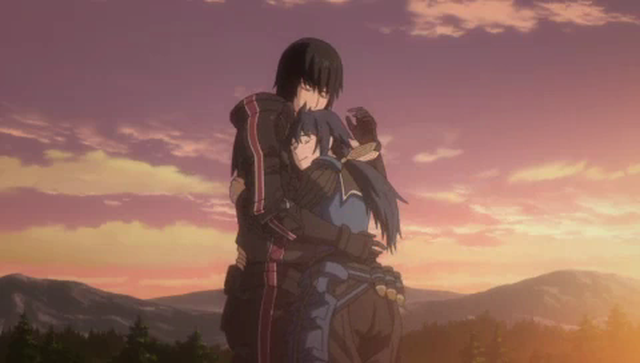
When I originally wrote about Valkyria Chronicles 3, I had considered it my favourite game in the franchise as I had recently completed it at the time I wrote that article.
Several years later, I’m not sure I would state that quite as confidently without replaying it first. Valkyria Chronicles 4 was really good. The fact that I’m even debating between the two says a lot about how well VC3 has held up.
This is a PSP game from 2011 that Sega never even bothered releasing outside Japan, and yet I still find myself thinking about its characters and mechanics more than a decade later. It takes the darker wartime atmosphere of the original game and combines it with many of the ideas introduced in Valkyria Chronicles 2.
The class system is more flexible, the grinding is dramatically reduced, even if it isn’t completely gone. The Nameless are a far more interesting group than Class G.
Kurt is a strong protagonist.
Gusurg’s defection gives the story a surprisingly personal conflict. Calamity Raven have motivations beyond simply being another collection of Imperial bad guys.
Riela finally gives us the opportunity to actually control a Valkyria.
Direct Command is such a good idea that Sega brought it back when the series finally returned to consoles with Valkyria Chronicles 4.
Even the areas where the game is clearly limited by the PSP don’t bother me as much as I would expect.
Would I prefer larger maps?
Sure.
Would I like more animated story sequences and less visual-novel presentation?
Absolutely.
Would I take a remake using the technology and scale of Valkyria Chronicles 4?
In a heartbeat.
But none of those limitations stop the game from working.
And now, thanks to the new English retranslation, there’s finally a way for me to go through the material I missed the first time. That’s probably the best excuse I’m ever going to get to revisit it.
Maybe once I’m finished I’ll still think Valkyria Chronicles 3 is the best game in the franchise.
Maybe Valkyria Chronicles 1 and 4 will keep that argument complicated.
Either way, VC3 deserves considerably more attention than the four-minute review I originally gave it. It isn’t just the strange Japan-only PSP entry sitting between Valkyria Chronicles 2 and Valkyria Chronicles 4. It’s the game where Sega took many of the experiments from VC2, refined them, brought back the more serious atmosphere of the original, and produced something that feels like a proper evolution of both.
More than fifteen years later, I think that’s held up remarkably well.
Rating:


-
Unlike its predecessor, Valkyria Chronicles 3 (VC3) does not have as much grinding to acquire materials. There are similar things in VC3, especially when it comes to unlocking potentials for characters like Kurt, Riela, or Imca, which are not clearly obvious. I would have to locate the guide I came across which indicated that you would need to do things like defeat 50 enemies to unlock a particular potential. ↩︎